


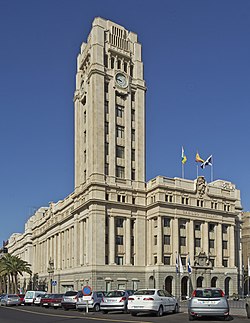
Palacio Insular de Tenerife est un bâtiment de la ville de Santa Cruz de Tenerife, dont il est le siège du Cabildo de Tenerife. Conçu par l'architecte José Enrique Marrero Regalado (es) et construit entre 1935 et 1940, il est situé sur la Place d'Espagne. L'édifice se distingue par sa tour surmontée d'une horloge rajoutée en 1950 et est l'un des symboles les plus reconnaissables de la ville de Santa Cruz de Tenerife.
Location
1 explorer visited this place
3 m
Palacio Insular de Tenerife is a building in the Spanish city of Santa Cruz de Tenerife, home of the Cabildo de Tenerife. Designed by the architect José Enrique Marrero Regalado, and executed between 1935 and 1940, it is located in the Plaza de España. The building stands out for its tower topped by a clock commissioned in 1950 and is one of the most recognizable symbols of the city of Santa Cruz de Tenerife.
The building project was the result of a contest that the County Council ruled in favor of the architect Enrique Marrero Regalado in 1934. The technician came to realize in collaboration with the architect Schneider four projects, two of which were monumental type and two rationalists; was elected the fourth solution, of great monumental packaging.
Works of art inside the building include the mural Salón Noble, designed by the Canarian painter José Aguiar. The project was signed in July 1934, beginning six months after the works, lasting jobs until 1940. "The breadth of the building made me think of reconciling its functions".
In January 2014 record for declaration of Site of cultural interest by the Government of the Canary Islands. In 2017 the entire building was declared as such.

8 m
Cabildo Insular de Tenerife is the governing body of the island of Tenerife. It was established on 16 March 1913 in Santa Cruz de Tenerife, in a session held by the City Council. It was, at that time, the first corporation.
The Cabildo of Tenerife, like the other councils of the Canary Islands, enjoys a number of local powers as contained in the Statute of Autonomy of the Canaries. Other powers are delegated to the ministries of the territorial government.

85 m
The Monument to the Fallen is a monument in Plaza de España, near the sea front of Santa Cruz de Tenerife, Spain. It is one of the several erected monuments across the Spanish geography that serve as memorial to the Nationalist victors in the Spanish Civil War.

120 m
The Plaza de la Candelaria, is a square in the city of Santa Cruz de Tenerife, which is located next to the Plaza de España.
In the square stands the monument of Triunfo de la Candelaria, also called the Obelisk of La Candelaria, which is one of the major sculptural monuments of the city, and is dedicated to the Virgin of Candelaria, the patroness of the Canary Islands, which is named this square.

120 m
The Castle of San Cristóbal in Santa Cruz de Tenerife was the first fortification of significance on the island of Tenerife and the main defensive building on Santa Cruz Bay. The central Castle Street is named after this fort.
Under the administration of Gov. Álvarez de Fonseca, construction began in 1575 but it was the January 20, 1577 when it entered service. The castle was demolished in 1928 to construct the Plaza de España, with the remains of the castle buried under it for centuries. On June 28, 2006, during the refurbishment of the Plaza of Spain, some remains were later found to belong to the castle. At that time precautionary and protective measures were taken in order to ensure the preservation of the find.
There remain only a few walls of the original building on display in a tunnel under the Plaza de España. Today, the castle is a museum which houses the famous "Cañón Tigre", which shot a musketball to Rear-Admiral Horatio Nelson's right arm, which fractured his humerus bone in multiple places on July 25, 1797, the reason why he had his arm amputated.
Book your tour near
Palacio Insular de Tenerife
Book Now
4.4
in partnership with
GetYourGuide.com