


Giedlarowa est une localité polonaise de la gmina et du powiat de Leżajsk en voïvodie des Basses-Carpates.
Location
1.2 km
Giedlarowa [ɡʲɛdlaˈrɔva] is a village in the administrative district of Gmina Leżajsk, within Leżajsk County, Subcarpathian Voivodeship, in south-eastern Poland.
4.4 km
Wólka Grodziska [ˈvulka ɡrɔˈd͡ʑiska] is a village in the administrative district of Gmina Grodzisko Dolne, within Leżajsk County, Subcarpathian Voivodeship, in south-eastern Poland.
4.8 km
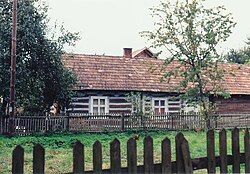
Grodzisko Górne [ɡrɔˈd͡ʑiskɔ ˈɡurnɛ] is a farming village in the administrative district of Gmina Grodzisko Dolne, within Leżajsk County, Subcarpathian Voivodeship, in south-eastern Poland.
The village is situated on the Wisłok river, which flows into the San river in Dębno, located near Leżajsk, on the edge of a Ruthenian settlement. The village separated itself as an independent administrative and economic unit from Grodzisko Dolne in 1786, along with another village called Grodzisko Nowe. In some cases, especially in immigration records, the two are referred to as one town called Grodzisko. The name Grodzisko comes from the word Gord, denoting a Slavic settlement. Grodzisko Górne itself was formerly a defensive settlement, as it is on the border with Ukraine. In 1881, an archaeological group from Kraków received a warrant to research the history of Grodzisko Górne. They found imprints of ancient settlements, probably dating back to immigrants from the 4th to 5th centuries. These archaeological works are still in progress today.
It is bordered by a canyon, whose north bank provided much of the defense for this village. In the village there is an ancient manor house, which was opened for tourism in the 19th century. It is maintained by a priest from Grodzisko Górne, Wojciech Micha.
The village employs many of the wage earners who reside in the rural commune of Grodzisko Dolne. The main industry is cloth manufacturing. Locally famous cloth markets are organized there. For farming, the major estate has 332 morgs of farmland and 58 meadows and gardens. The minor estate has 3200 morgs of farmland, 341 morgs of meadows and gardens, 216 morgs of pasture land and 428 morgs of forest.
Today there is a three-grade schoolhouse and a post office in the village, serving its population of 5094, including 364 Jews.
4.8 km
Gmina Leżajsk is a rural gmina in Leżajsk County, Subcarpathian Voivodeship, in south-eastern Poland. Its seat is the town of Leżajsk, although the town is not part of the territory of the gmina.
The gmina covers an area of 198.5 square kilometres. In 2006 its total population was 19,832, 20,051 in 2011, and 19,795 in 2024.
4.8 km
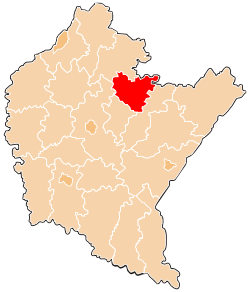
Leżajsk County is a unit of territorial administration and local government in Subcarpathian Voivodeship, south-eastern Poland. It came into being on January 1, 1999, as a result of the Polish local government reforms passed in 1998. Its administrative seat and largest town is Leżajsk, which lies 41 kilometres north-east of the regional capital Rzeszów. The only other town in the county is Nowa Sarzyna, lying 11 km north-west of Leżajsk.
The county covers an area of 583.01 square kilometres. As of 2019 its total population is 69,479, of which the population of Leżajsk is 13,853, that of Nowa Sarzyna is 5,834, and the rural population is 49,792.