


L'hôpital bourgeois de Sélestat est un monument historique situé à Sélestat, dans le département français du Bas-Rhin.
Gallery


Sponsored
Location

234 m
The Church of Saint Faith of Sélestat is a major Romanesque architecture landmark in Sélestat along the Route Romane d'Alsace in eastern France. The church having been built over a very short time span, it appears strikingly homogenous in style and proportions, however some parts have been completed and others modified in a Romanesque Revival style by the architect Charles Winckler between 1889 and 1893. During that restoration campaign, a crypt dating back to around 1085 was discovered and made accessible as well. Like many major buildings in Alsace the church is made of pink Vosges mountains sandstone.
322 m
The siege of Sélestat was a siege, extending from 20 to 24 October 1870, of the French Alsatian fortress of Sélestat, during the Franco-Prussian War. After artillery bombardment by the Germans, the siege ended when the French army surrendered, mainly because the French garrison was demoralized. The Germans suffered only minor losses, while this victory brought them many spoils.

322 m
Sélestat is a commune in the Grand Est region of France. An administrative division of the Bas-Rhin department, the town lies on the Ill river, 17 kilometres from the Rhine and the German border. Sélestat is located between the largest communes of Alsace, Strasbourg and Mulhouse. In 2023, Sélestat had a total population of 19,589.
First mentioned in the 8th century, Sélestat later became a free imperial city of the Holy Roman Empire and prospered as a member of the Décapole. During the Renaissance, it was a noted centre of humanism. Sélestat's fortunes declined amid the turmoil of the Reformation and experienced constant warfare. Following the Peace of Westphalia in 1648, it was formally annexed by France, under which its decline continued though it remained a town of strategic importance.
Sélestat's city walls, reconstructed by Vauban in the late 17th century, were demolished in 1874 after the town was annexed by the German Empire. It became French again after the First World War, was again annexed by Germany during the Second World War, before finally returning to France. Since 1945, Sélestat has experienced steady growth and become a regional industrial centre and commercial hub.
Sélestat's well-preserved old town features a distinct blend of French and German cultural heritage and is site to numerous architectural landmarks from the Middle Ages and Renaissance. The Humanist Library, inscribed by UNESCO in its Memory of the World Register, houses one of the oldest and most homogeneous collections of medieval and Renaissance works in Europe.

322 m
St. George's Church, Sélestat, is a Gothic church in Sélestat, Bas-Rhin, Alsace, France. The church, of exceptional size and quality, is near the Humanist Library, which was founded in 1452 by Jean de Westhuss, priest at the church of St. George's. Originally dedicated to the Blessed Virgin Mary, the church has been named after Saint George since 1500 and is famous for its Christmas trees hung since 1521
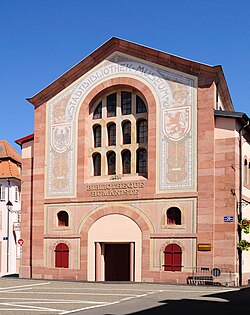
394 m
The Humanist Library in Sélestat is one of the most important cultural treasures of Alsace, France. There are two Renaissance humanist libraries involved, the library of the Humanist School and the private library of the scholar, Beatus Rhenanus.