


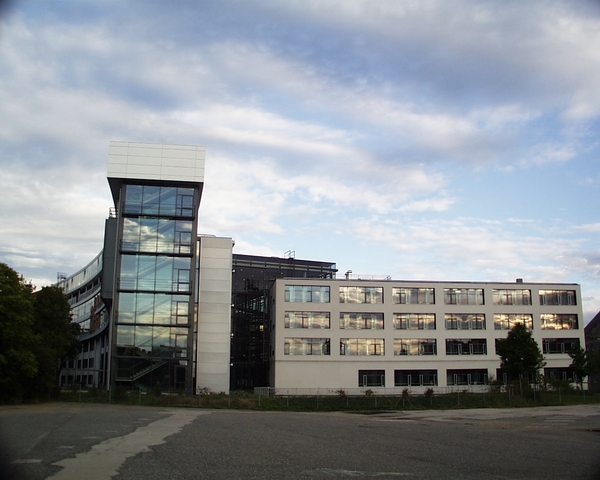
L'Institut Max-Planck d'anthropologie évolutive (en allemand : Max-Planck-Institut für evolutionäre Anthropologie) est un institut de recherche situé à Leipzig, en Allemagne et créé en 1997. Il fait partie du réseau de centres de recherches de la Société Max-Planck.
Location
1 explorer visited this place

0 m
The Max Planck Institute for Evolutionary Anthropology is a research institute based in Leipzig, Germany, that was founded in 1997. It is part of the Max Planck Society network.
Well-known scientists currently based at the institute include founding director Svante Pääbo and Johannes Krause, Christophe Boesch, Jean-Jacques Hublin, Richard McElreath, and Russell Gray.

73 m
Bio City Leipzig in Leipzig is a business incubator in the field of biotechnology. With the start of the "Biotechnology Offensive Saxony" in 2000 and with the concept of uniting business and science under one roof, the foundation stone was laid on 8 February 2002. The opening of the centre took place on 23 May 2003. The total investment volume was €50 million, including €12.9 million from the City of Leipzig. The landlord is LGH - Leipziger Gewerbehof GmbH & Co. KG and tenant management is operated by leap:up GmbH. Until February 2025, leap:up was named biosaxony Management GmbH.

236 m
The German Museum of Books and Writing) in Leipzig, Germany, founded in 1884 as Deutsches Buchgewerbe-Museum, is the world's oldest museum of its kind, dedicated to collecting and preserving objects and documents as well as literature connected with the history of books, including paper, printing techniques, the art of illustration, and bookbinding. The museum is housed in a modern €60 million annex to the German National Library in Leipzig built in 2011.
In 1886, the museum acquired the entire book collection of Heinrich Klemm, which he had sold to the Kingdom of Saxony the year before. A rare copy of a 42-line Gutenberg Bible printed on vellum was among the books in the collection. At the end of World War II, the Bible was taken as war booty and transferred to the Russian State Library in Moscow, where it remains today.

254 m
The German Music Archive in Leipzig, is the central collection of printed and recorded music and the music-bibliographic information centre for Germany. It is a Federal agency founded in 1970, tasked with collecting all music published in the country. Publishers of printed and recorded music in Germany are required by law to deliver two copies of every edition as legal deposits to the archive.
The DMA constitutes a department of the German National Library, Leipzig.

440 m
The Russian Memorial Church of Saint Alexius is a Russian Orthodox church in Leipzig, Germany. It was inaugurated and dedicated from October 17–18, 1913, one hundred years after the Battle of Leipzig. The memorial commemorates the 127,000 Russian troops who served in the Battle, including the 22,000 who died freeing the Germans. In 1813, the German-speaking Austrians and Prussians had been united with the Russians in their battle against Napoleon and the French. Less than a year after the dedication of this centenary memorial, a different set of alliances resulted in World War I.
The church was named after St. Alexius, a Metropolitan of Moscow from the 14th century. Many external and internal features make this church unique, including a wall of icons, a large chandelier, tablets bearing inscriptions on either side of the doors and four coffins containing the remains of soldiers who fought in the Battle of Leipzig. Its fortunes have varied, partly based on Leipzig's government. After Russians occupied Leipzig in World War II, they began to take care of the church and inserted a new plaque extending the purpose of the church to commemorate Russian soldiers down to 1945.
The church continues to serve as a place of worship for a congregation of about 300 with a weekly attendance of about 100. It is part of the Russian Orthodox Church. Both interior and exterior portions of the church have undergone necessary renovations in recent decades. Structural work began in 2012 in preparation for the building's centennial and restoration of the wall of icons was completed in 2018.