


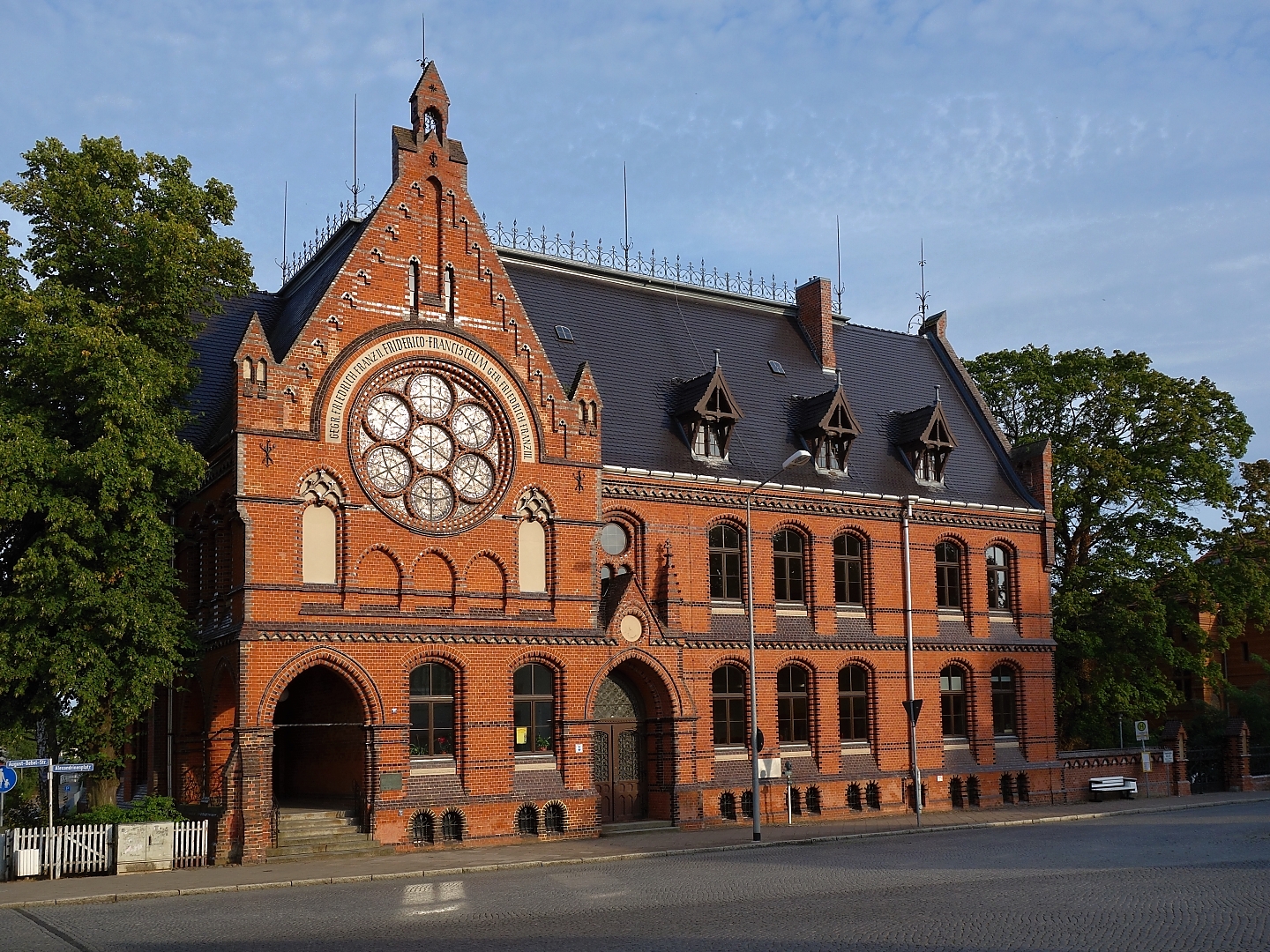
The Friderico-Francisceum (FFG) is a gymnasium in Bad Doberan, Germany.
Book your tour near
Friderico-Francisceum
Book Now
4.1
in partnership with
GetYourGuide.com
Gallery

Sponsored
Location
1 explorer visited this place

287 m
Bad Doberan is a town in the district of Rostock, Mecklenburg-Vorpommern, Germany. It was the capital of the former district of Bad Doberan. In 2012, its population was 11,427.

477 m
Bad Doberan station is a railway station in the town of Bad Doberan, located in the district of Rostock, Mecklenburg-Vorpommern, Germany.

524 m
The Doberan Minster is the main Lutheran Church of Bad Doberan in Mecklenburg, Germany. Close to the Baltic Sea and the Hanseatic city of Rostock, it is the most important religious heritage of the European Route of Brick Gothic. It is the remaining part of Doberan Abbey, a former Cistercian monastery dedicated in 1368. The first abbey in Mecklenburg, founded in 1171, which was also used as the burial site for the regional rulers, became important both politically and historically. Through the activities of its inhabitants, the abbey greatly contributed to the cultural and economic development of Mecklenburg and became the centre of Christianity in this region.
No other Cistercian abbey in Europe can lay claim to such a large amount of the original interior remaining intact. Among the treasures are the main altar which is the oldest winged altar in art history, the monumental cross altar and the sculpted tomb of Danish Queen Margarete Sambiria. Even after the reformation and the dissolution of the abbey in 1552, the church continued to serve as the main burial place for the ruling Mecklenburg family as well as the place of worship for the Evangelical-Lutheran congregation.
The Minster in Bad Doberan is said to be the most important medieval building in Mecklenburg-Vorpommern, the best example of medieval creativity put into practice and it is a building of the highest technical and artistic perfection. The furnishings on display are of highest artistic quality. No other church in northern Germany has such complete and historically important liturgical furnishings. The abbey is a unique and precious artistic monument in the coastal region of the Baltic Sea.

549 m
Doberan Abbey is a former Cistercian monastery in Bad Doberan, Mecklenburg-Vorpommern, Germany. The Brick Gothic church continues in use as Doberan Minster.
After the conversion to Christianity of the Wendish prince Pribislav, Doberan was the first monastery founded in Mecklenburg, in 1171, as a daughter house of Amelungsborn Abbey. The abbey was refounded at Doberan in 1186 after the original community, at Althof, was killed in 1179 during the upheaval after Pribislaw's death. It quickly became a political, social and spiritual centre in the region. The abbey church, which continues in use as Doberan Minster, is one of the most important Brick Gothic buildings in Mecklenburg-Vorpommern. Until the Reformation, during which it was secularised in 1552, the abbey possessed great estates, and was the burial place of the Princes of Mecklenburg.
The premises was badly damaged in 1637 during the Thirty Years' War, when the minster was used as a storage depot, and some buildings were destroyed. During the French occupation of Mecklenburg under Napoleon from 1806 to 1813 more damage was sustained, and the church was again used as an ammunition dump. Between 1883 and 1896 the church was "restored" in an inappropriate 19th century Gothic Revival style, which was undone in a further restoration in the 1960s and 1970s.

564 m
Bad Doberan-Land is an Amt in the district of Rostock, in Mecklenburg-Vorpommern, Germany. The seat of the Amt is in Bad Doberan, itself not part of the Amt.