

 English
 Français

St John Street, Manchester
St John Street is a street in central Manchester, England. It consists mainly of late Georgian and Regency era terraced houses. Laid out between 1770 and 1830, the street runs roughly east–west between Deansgate and Byrom Street, terminating in an urban park, formerly the site of St John's Church, at its eastern end. Originally built for the prosperous Manchester upper-middle classes, by the 20th century it had become the preserve of the medical and legal professions. In the 21st century, some of the buildings are being reconverted to residential use. The only surviving Georgian terraced street in central Manchester, many of its buildings are listed.
Nearby Places View Menu

97 m
St John's Gardens, Manchester
St John's Gardens in central Manchester, England, lies between Lower Byrom Street, Byrom Street and Quay Street. Previously occupied by St John's Church and its graveyard between 1769 and 1931, the site was redeveloped into a formal garden in 1932. It contains a central memorial to the church and those buried in its graveyard, whose tombstones have been covered over by 18 inches (460 mm) of soil except for that of John Owens, founder of Owen's College.
The garden was awarded a Green Flag in 2012 and is part of the St John Street conservation area.

97 m
St John's Church, Manchester
St John's Church, Manchester, also known as St John's, Deansgate, was an Anglican parish church in Manchester, England, established in 1769 and demolished in 1931. Its site is now that of St John's Gardens, situated between Lower Byrom Street, Byrom Street and Quay Street.
St John's Church was built in 1769 by Edward Byrom, a co-founder of the first bank in Manchester. Its parish encompassed a large and important section of the city of Manchester. The first rector, John Clowes, held the office for 62 years until his death in 1831. Clowes preached the first Sunday school sermon in the Manchester area, introduced Swedenborgianism there and was prominent in championing Whit Walks. Clowes was succeeded by William Huntington, who had held the post of curate since 1826 and continued as rector until his death in 1874. Huntington established the Sunday school, for which he laid the foundation stone in 1827. In 1906, around 250 children attended the Sunday school and the church had numerous affiliated groups, such as a Penny Bank and a Choral Society. By the early 1900s, the graveyard was overshadowed on its northern side by a warehouse built on the Quay Street site of the Byrom family residence, and with a declining congregation and some redundancy of provision given the nearby St Matthew's Church, the Manchester diocese decided to merge the parish of St John's with St Matthew's in 1927. As a result, the church was demolished in 1931.
The church has been described as the first significant building in Manchester to be constructed in the Gothic Revival style of architecture. Construction of the tower, which contained a peal of eight bells manufactured by Lester and Pack, was completed in May 1770. The first restoration took place in 1821, including a re-roofing paid for by a daughter of Byrom. Between 1874 and 1878 work was done at a cost of £1,600 and in 1898 the lighting was converted from gas to electric. The church bells, which were described as "among the best peal of bells in Manchester", were rehung in 1832 and again around 1883. The roof collapsed in 1924 and was rebuilt by 1926. Among people who were commemorated in the church windows were John Owens, and Sir Thomas Bazley.
Today the graveyard of the church is commemorated by a stone cross and a plaque states that more than 22,000 bodies lie buried in the vicinity. Among those buried in the churchyard are John Owens, the founder of Owens College, and William Marsden, who founded the concept of a half-day holiday on Saturdays.

131 m
County Court, Manchester
The County Court is a Georgian townhouse on Quay Street in Manchester, England, that served as the city's county court from 1878 to 1990. It was the home of the politician and reformer Richard Cobden, and later the site of Owens College, the forerunner of the University of Manchester. In origin, it is a townhouse of the 1770s, described as "the best preserved Georgian house in the [city] centre". The house is built of brick and has a late 19th-century doorcase. It was designated a Grade II* listed building on 3 October 1974. The interior is not original.
135 m
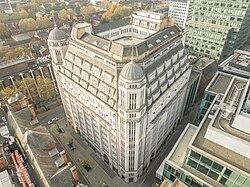
Sunlight House
Sunlight House is a Grade II listed building in the Art Deco style on Quay Street in Manchester, England. Completed in 1932 for Joseph Sunlight, at 14 storeys it was the tallest building in Manchester, and the top floors of turrets and multiple dormer windows and mansard roofs create a distinctive skyline.