



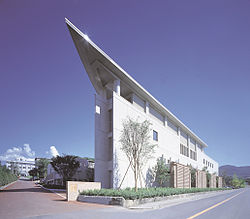
Ueda Women's Junior College (上田女子短期大学, Ueda joshi tanki daigaku) is a private women's junior college in Ueda, Nagano, Japan, established in 1967.
Location
1 explorer visited this place
217 m
Nagano University is a public university in Ueda, Nagano, Japan, established in 1966. A private university when founded, it became a public university in 2017.

1.0 km
Ikushimatarushima Shrine, also known as Ikushima Tarushima Shrine, is a Shinto shrine located in Ueda, Nagano Prefecture Japan. It is a Beppyo shrine, or a shrine that is particularly notable in a certain way with a significant history to it. It is also a Myojin Taisha recorded as a highly ranked Shrine in the Engishiki in 927.
It enshrines Ikushima Okami and Tarushima Okami.
The Ikushimatarushima Shrine is home to a series of allegiance pledges given to Shingen by over a hundred retainers, originating from the years 1566 and 1567.
It is described as a Ubusuna-jinja or one with a very local focus.
Its name comes from two deities: Ikushima-no-kami; and Tarushima-no-kami.

3.0 km
The Battle of Uedahara was the first defeat suffered by Takeda Shingen, and the first field battle in Japan in which firearms were used. It took place in Shinano Province or the modern-day Nagano Prefecture.
4.4 km
The siege of Ueda was staged in 1600 by Tokugawa Hidetada, son and heir of the warlord Tokugawa Ieyasu, against Ueda castle garrison in Shinano province, which was controlled by the Sanada family.
Hidetada came across the castle as he marched his army along the Nakasendō from Edo to rendezvous with his father's forces. Sanada Masayuki resisted, and Sanada Yukimura, second son of Masayuki, was able to fight Hidetada's 38,000 men with only 2,000. However, when the castle did not fall as quickly as Hidetada had hoped and expected, he gave up and abandoned the siege and hurried to meet up with his father. As a result of this delay, Hidetada missed the battle of Sekigahara, the decisive victory in his father's unification of Japan.

4.4 km
Ueda Castle is a Japanese castle located in Ueda, northern Nagano Prefecture, Japan. At the end of the Edo period, Ueda Castle was home to a cadet branch of the Matsudaira clan, daimyō of Ueda Domain, but the castle is better known for its association with the Sengoku period Sanada clan. It was also called Amagafuji-jō or Matsuo-jō. The castle was designated a National Historic Site of Japan in 1934.