Location Image

Château de Mains

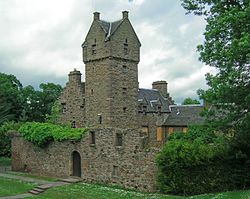
Le château de Mains (également connu sous le nom de château de Claverhouse ou de château de Fintry) est un château du XVIe siècle situé à Dundee, en Écosse. Le château se compose de plusieurs bâtiments entourant une cour, bien que plusieurs des bâtiments occidentaux d'origine n'existent plus. Les bâtiments nord et est sont l'endroit où aurait vécu la famille, les domestiques occupant les quartiers sud. Le château possède également une grande maison-tour carrée de six étages avec des pierres angulaires taillées, typique de la construction du XVIe siècle. Il s'agit d'un bâtiment classé de catégorie A. Le château est situé dans le parc Caird de Dundee, au nord de la ville, surplombant la vallée de Dichty et à côté d'un petit ruisseau connu sous le nom de Gelly Burn. De l'autre côté du brûlage se trouvent le mausolée de la famille Graham et le cimetière de Main, qui était autrefois l'emplacement de l'église du quartier. Le château et son parc ont fait l'objet d'un poème du poète de Dundee William McGonagall dans son œuvre The Castle of Mains.

Nearby Places View Menu
Location Image
0 m

Mains Castle

Mains Castle (also known as Claverhouse Castle or Fintry Castle ) is a 16th-century castle in Dundee, Scotland. The castle consists of several buildings surrounding a courtyard, although several of the original western buildings no longer exist. The northern and eastern buildings are where the family would have lived, with the servants occupying the southern quarters. The castle also has a large, six-floor, square tower house with dressed cornerstones, which is typical of 16th-century construction. It is a Category A listed building. The castle is located in Dundee's Caird Park to the north of the city overlooking the Dichty valley and adjacent to a small stream known as the Gelly Burn. On the opposite side of the burn is located the mausoleum of the Graham family and the Main's cemetery, which was formerly the site of the district's kirk. The castle and its grounds was the subject of a poem by Dundee poet William McGonagall in his work The Castle of Mains.
321 m

Caird Park Velodrome

The Caird Park Velodrome is an outdoor 402.25-metre (1,319.7 ft) concrete velodrome in Dundee, Scotland. Adjacent to the velodrome is an athletics stadium with a 400-metre (1,300 ft) running track, 18- and 9-hole golf courses, several football pitches and a rugby pitch, whilst in the centre of the velodrome is a football pitch, as it is one of two major outdoor sport complexes in the city. In 2012 Sport Scotland spent £300,000 on redevelopment of the velodrome. The velodrome is home to the Discovery Juniors Cycling Club, which Scottish gold medal cyclist Mark Stewart was a member of. Since his gold medal win at the 2018 Commonwealth Games in the Gold Coast, Australia, there have been calls for the velodrome to be renamed after him. Had Scotland and Ireland's UEFA Euro 2008 bid been successful, a new stadium would have been built in Caird Park.
Location Image
457 m

Mill of Mains

Mill of Mains is a residential area located in the north of Dundee, Scotland.
857 m

Woodside, Dundee

Woodside is a small housing area in the north of Dundee, Scotland. The area runs between Graham Street, Mains Loan and lengthwise to the Kingsway. The residential housing is mainly 1920s constructions with four homes to a block. The area is within a walkable distance of the amenities of Clepington Road, however it is home to one corner shop, Graham St. News. Xplore Dundee service the area with the No. 21 - Woodside route, which runs Monday to Saturday, from 05:50 until 18:20. A Sunday service is provided by the redirected 18A - Kirkton.
Location Image
885 m

Trottick Mill Ponds

Trottick Mill Ponds and Nature Reserve is a local nature reserve located in the Trottick area in Dundee, Scotland. The nature reserve connects with the Dighty Burn and is voluntarily operated by Countryside Rangers as well as the Scottish Wildlife Trust and owned by Dundee City Council.