


La rue du Thier-à-Liège est une rue faisant partie du quartier administratif de Thier-à-Liège à Liège en Belgique.
Location

1.2 km
Vottem is a village of Wallonia and a district of the municipality of Herstal, located in the province of Liège, Belgium. The Rida river has its springs in Vottem.
It was a fully-fledged municipality up to 1976. The Jolivet and Bernalmont hamlets had already been transferred to the town of Liège in 1975.

1.3 km
Les Ardentes or Ardentes are a Belgian multi-day electro-rock music festival which yearly takes place in Liège, in early July. The last edition of the event took place in the district of Rocourt. Les Ardentes is organised ever since 2006, with Fabrice Lamproie and Gaëtan Servais as founders. The festival name is a French plural noun meaning "The Burning", a referral to the nickname of host city Liège, La cité ardente.
Les Ardentes is one of the major festivals in the Meuse–Rhine Euroregion. Attendance rose from 25,000 spectators at the first event to 200,000 in 2022. Since 2008, it is a four-day event whereas before, it lasted for three days. Les Ardentes has different stages on which the artists perform, the largest being situated in the centre of the park and others situated in the Halles des foires. The festival is easily accessible by public transport - bus or train.
1.4 km
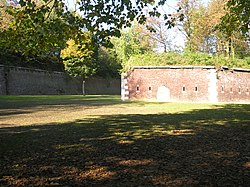
The Citadel of Liège was the central fortification of the strategic Belgian city of Liège, Wallonia, until the end of the 19th century. It is located in the Sainte-Walburge neighborhood, 111 metres above the Meuse valley. Together with those at Dinant, Huy and Namur, the Citadel of Liège forms part of the so-called Meuse Citadels.
The first citadel was built on the heights overlooking the city in 1255. It was rebuilt in a pentagonal shape by Prince-Bishop Maximilian Henry of Bavaria in 1650. This fortress was destroyed by France shortly afterwards, then rebuilt in 1684. During the Napoleonic Wars, it was given five bastions in the style of Vauban. By the late 19th century, the citadel had become obsolete as a fort, replaced by the twelve forts of the Fortified Position of Liège, though it continued in use as a barracks and as a command post for the Fortified Position, contributing to the country's National Redoubt.
In the 1970s, the citadel was largely destroyed by the construction of a hospital on the site. The southern walls remain. An area on the north side is a memorial to Belgians executed in the citadel by German occupiers in World Wars I and II, while 20th-century bunkers remain on the south side.

1.5 km
The Hôtel d'Ansembourg is a former Baroque hôtel particulier in Liège, Belgium, located between Féronstrée and quai de Maestricht.

1.5 km
The Collegiate Church of St. Bartholomew is a Roman Catholic collegiate church in Liège, Belgium. Founded outside the city walls, it was built in coal sandstone, starting in the late 11th century and lasting until the late 12th century. It underwent, like most ancient religious buildings, modifications through the centuries. Nevertheless, the Meuse Romanesque—Ottonian architecture character of its architecture remained deeply rooted. The 18th century saw the addition of two more aisles, the opening of a neoclassical portal in the walls of the westwork, and the French Baroque redecoration of the interior. The interior of the western section has recently been restored back to the original style.
The Collegiate Church of St. Bartholomew was one of the original seven collegiate churches of Liège, which also included the Churches of St. Peter, St. Paul, St. John, St. Denis, St. Martin, and the Holy Cross, and until the Liège Revolution of 1789 collectively comprised the "secondary clergy" in the First Estate of the Prince-bishopric of Liège.
In 2006, the church emerged from heavy restoration work lasting seven years and involving 10,000 replaced stones and the restoration of the polychromy of the walls).