


Roch (Welsh: Y Garn) is a village and ecclesiastical parish 2 miles (3.5 km) northeast of Nolton and 5.5 miles (9 km) northwest of Haverfordwest. It forms part of the community of Nolton and Roch. Roch ecclesiastical parish includes the hamlets of Cuffern and Druidston. Census population of Roch parish 538 (1801): 763 (1851): 471 (1901): 377 (1951): 684 (1981) In the 2011 census Roch village had a population of 463.
Gallery

Sponsored
Location
79 m
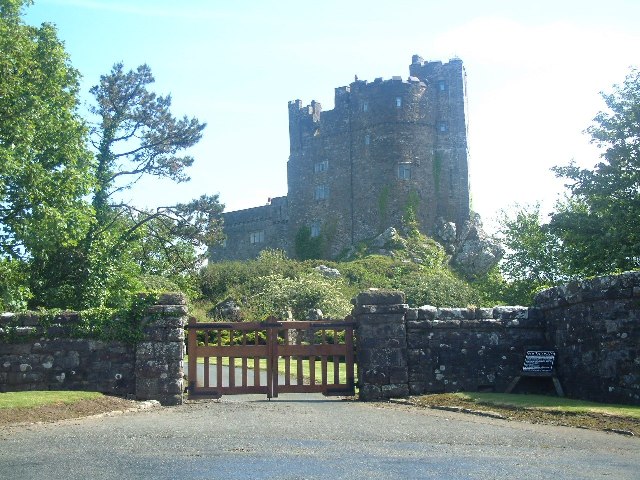
Roch Castle is a 13th-century castle, located at Roch near Haverfordwest, Wales.
Built by Norman knight Adam de Rupe circa 1200, probably on the site of an earlier wooden structure. Roche is the usual French word for rock, while rupestre signifies a plant growing among rocks.
Built at the same time as Pill Priory near Milford Haven, Roch Castle was probably built in this location as one of the outer defences of "Little England" or "Landsker", as it is located near the unmarked border which for centuries has separated the English and Welsh areas of Pembrokeshire.
After the deRupe family died out in the 15th century, the Castle was taken over eventually in the 17th century by the Walter family. Their daughter Lucy was born in the castle, and later became a courtesan of Charles II, and bore him an acknowledged son James, 1st Duke of Monmouth.
During the English Civil War, the Walter family declared for King Charles I. Although Pembrokeshire was initially Royalist, the Puritans gained the upper hand. The castle changed hands twice, before the Walter family fled when it was captured for a second time by the Parliamentary forces and subsequently burned in 1644. It lay dormant and unclaimed until the return of Duke of Monmouth, who led a rebellion and was captured at the Battle of Sedgemoor, and then beheaded on 15 July 1685.
The castle remained decaying until 1900, when purchased by John Philipps, 1st Viscount St Davids, who restored it with a steel frame and new concrete floors to the designs of D. E. Thomas of Haverfordwest. Further works were carried out in 1910 and circa 1918–20, the latter by D. F. Ingleton.
The castle was purchased in 2008 by Keith Griffiths and was restored as a hotel. Completed in 2013, the restoration was designed by Griffiths and Acanthus Holden. The hotel has won a number of awards.

1.3 km
Cuffern Manor in Roch, Pembrokeshire is a house of historical significance and is listed on the Wales Heritage Register. It was built in 1770 by John Rees Stokes shortly after he inherited a fortune from his cousin. It remained in the Stokes family for the next 150 years. Today it provides bed and breakfast accommodation and caters for special events, particularly weddings.
1.8 km
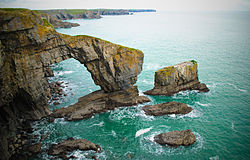
Pembrokeshire Coast National Park is a national park along the Pembrokeshire coast in west Wales.
It was established as a national park in 1952. It is one of three national parks in Wales, the others being Brecon Beacons and Snowdonia. It is the only national park in the United Kingdom to consist largely of coastal landscapes.
2.3 km
The Pembrokeshire Motor Museum used to exhibit a range of restored vintage cars. It was located at Simpson Cross, in Pembrokeshire, West Wales on the A487 road, about 4 miles from Haverfordwest. The museum displayed over 40 vehicles covering the history of the motor car.
The privately owned museum was opened in 2000 by Mike Richards. The exhibitions included displays of model vehicles, motorcycles, bicycles, signs and other ephemera, a dining area and bar, video and magazine lounge and a play area for young people.

3.1 km
Nolton Haven is a hamlet halfway along the coast of St Brides Bay in Pembrokeshire, Wales. It is included within the Pembrokeshire Coast National Park. Together with the larger inland village of Nolton which is about 1 km to the southeast and the village of Roch, Nolton Haven falls within Nolton and Roch community.
The village stands on a prominent ridge of Precambrian rhyolite.