


Great Work Mine was a Cornish mine between Godolphin hill and Tregonning Hill and is in the hamlet of Great Work on Bal Lane. Great Work is notable for its unusual chimney stack with the upper brick-work in two stages. The remaining ruin of the mine sits 400 ft above sea level, and is part of the Cornwall and West Devon Mining Landscape.
Gallery


Sponsored
Location
1 explorer visited this place

787 m
Balwest is a hamlet in the civil parish of Germoe in west Cornwall, England, in the United Kingdom.
The hamlet is on the southern edge of a former mining area, part of a geological formation known as the Tregonning-Godolphin Granite which was formerly an important source of tin and copper ore.
A Wesleyan Methodist chapel was opened at Balwest in 1829 for miners. The building is Grade II listed.
938 m
Boscreege is a small village in the civil parish of Germoe in west Cornwall, in England, United Kingdom.
The village is on the southern edge of a former mining area, part of a geological formation known as the Tregonning-Godolphin Granite which was formerly an important source of tin and copper ore.
The name Boscreege is an anglicisation of the Cornish language Boskrug, which contains the words bos 'dwelling' and krug 'barrow, mound'.
1.2 km
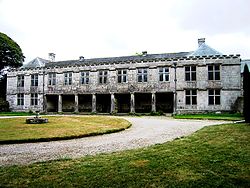
The Godolphin Estate is a National Trust property situated in Godolphin Cross, 7 km north-west of Helston in Cornwall, England. The house is a Grade I listed building.

1.3 km
Tregonning Hill is the westerly of two granite hills overlooking Mount's Bay in west Cornwall, England, United Kingdom, the other being Godolphin Hill. They are approximately 6 kilometres west of the town of Helston. The Plymouth chemist William Cookworthy mixed china stone with kaolin, mined from the hill to make Plymouth porcelain in 1768; which was the first time hard-paste porcelain was made in Britain. Part of the hill is designated as a Site of Special Scientific Interest and at the date of notification was the only known site of western rustwort in Great Britain.
In July 2023 the hill was listed by Estate Agents for £150,000 and bought by the Cornwall Heritage Trust in November.

1.4 km
Godolphin Cross is a village in the civil parish of Breage, in west Cornwall, England. It is midway between the towns of Hayle and Helston. From 1974 until 2009 it was in Kerrier district.
Godolphin Cross is in an upland area, part of a geological formation known as the Tregonning-Godolphin Granite. The term refers to the plateau of high ground in this area, one of five granite batholiths in Cornwall. One mile west of the village, Godolphin Hill rises to 162 metres.
The Godolphin Estate is near the village. It is now completely owned by the National Trust, and is undergoing extensive renovation. The whole estate and surrounding woodlands are once again open to the public, who were excluded from most of the estate by the former owners. Godolphin Primary School serves children from 4 to 11 years and had a roll of 82 children in November 2021. It received a good Ofsted report in June 2015.
The Church of St John the Baptist is now redundant. It was designed by James Piers St Aubyn and built in 1849–50. In 2006, an application was received by Kerrier District Council to convert the church into a private dwelling.
There is a Cornish cross in the churchyard. In 1886 it was moved to the churchyard, having been found in use as a gatepost on the Chytodden estate.
In 2017 funds for the purchase of the village hall were provided by Sheikh Mohammed bin Rashid Al Maktoum, the ruler of Dubai. Villagers had appealed to him for help, on the basis of the connection between the village and Godolphin Arabian, one of three stallions from which all thoroughbreds are descended. Al Maktoum is the owner of the Godolphin Racing stable. The building was formerly the Methodist Chapel and school room.
The site is owned by the National Trust and forms part of the Godolphin Estate along with Godolphin House.