


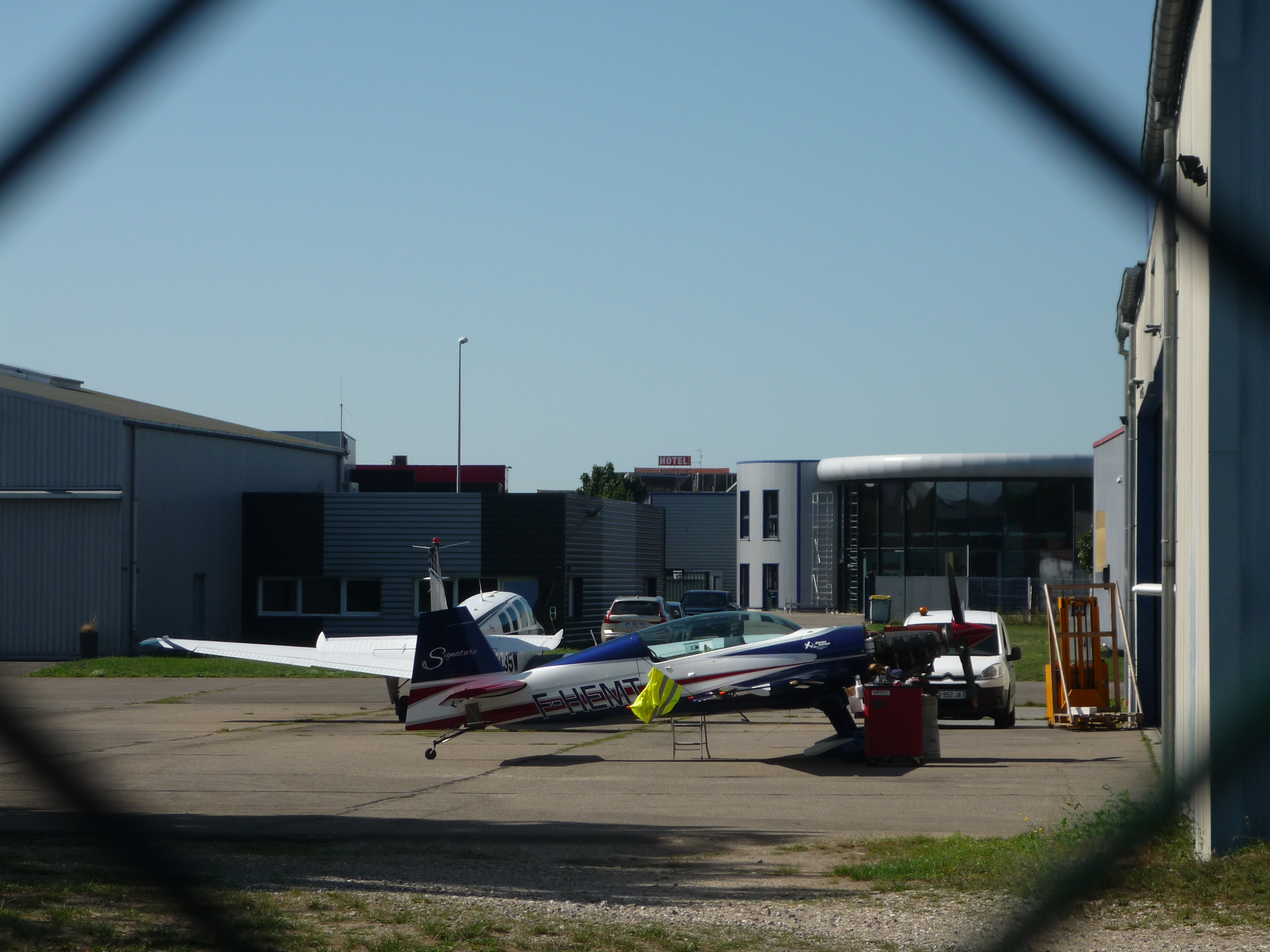
L’aérodrome de Haguenau (code OACI : LFSH) est un aérodrome civil, ouvert à la circulation aérienne publique (CAP), situé à 3 km au sud-est d’Haguenau dans le Bas-Rhin (région Grand Est, France). Il est utilisé pour la pratique d’activités de loisirs et de tourisme (aviation légère, hélicoptère et aéromodélisme).
Gallery



Sponsored
Location
1.2 km
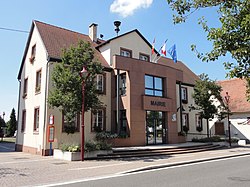
Kaltenhouse is a commune in the Bas-Rhin department in Grand Est in north-eastern France. It lies a short distance to the southeast of Haguenau.

1.9 km
The Basilica of Notre-Dame, Marienthal, is a Roman Catholic pilgrimage church dedicated to the Blessed Virgin Mary. Located in Marienthal, in the Bas-Rhin department of France, it is administratively situated in the town of Haguenau.
Pope Pius IX crowned the dolorous Marian image, enshrined within the basilica, on 19 September 1859. Pope Leo XIII elevated the status of the shrine to Minor basilica on 31 May 1892.
The first sanctuary at this site was built around 1250 by the knight Albert of Haguenau, who had had a religious epiphany some ten years prior and had gathered a small community of faithful around him. This first sanctuary, called "Mary in the Valley", venerated a statue of the Madonna and Child which is not preserved today. The two statues that are venerated today, a Madonna and Child and a Pietà, date from the early 15th century. In the 18th century, the basilica also received precious gifts from queen consort Marie Leszczyńska.
The current, spacious church was built in 1863–1866 in the Gothic Revival style, but keeps a Late Gothic sacristy from 1519, decorated with early Renaissance bosses, and elaborate works of art such as a Dormition of Virgin Mary, and an Entombment of Christ, carved in sandstone by the local master sculptor, Friedrich Hammer. Among the 19th-century works of art in the basilica figures a set of frescoes by Martin von Feuerstein.

2.7 km
The Musée historique is one of the three museums of Haguenau, France. It was established in 1900 and inaugurated in 1905, when Haguenau was a German town and part of Alsace-Lorraine. In spite of its name, it is as much an art museum as a museum dedicated to History.
The museum was founded by the mayor, Xavier Nessel, who was also a keen amateur archaeologist. The building was initially designed to house the municipal collections, the municipal archive and the municipal library. It was built by the architects Joseph Müller and Richard Kuder who also designed the Strassburger Sängerhaus.
Apart from artefacts relating to the history of the town, including its Jewish community, the museum owns a rich collection of archaeological finds from the Neolithic, the Bronze Age, the Iron Age and the Gallo-Roman period. It also displays a number of Romanesque, Gothic, Renaissance and Baroque artworks from religious and secular buildings from the town and its surroundings; in many cases, those buildings themselves have long disappeared. The museum also owns a collection of Strasbourg faience by the Hannong Family and a collection of modern art, including Art Nouveau glassware) and paintings.
The ethnographic and folk art collections relating to Alsace were moved to the Musée alsacien nearby in 1972.

3.0 km
The Museé alsacien is one of the three museums of Haguenau, France. Like its older and much larger counterpart in Strasbourg, it is dedicated to local, mostly rural customs, furniture, and folk art.
The museum was established in 1972 when the ethnographic collection of the Musée historique de Haguenau was separated from the rest of the collections to reorganise the existing space. It was moved into the former chancery, a late 15th-century building.

3.0 km
Ancienne Douane is a Renaissance and Renaissance Revival building in Haguenau, France. It originally stood at the entrance of the town.
The building was built in 1515–1518 but heavily damaged in 1677, during the military campaign of Louis XIV against the Décapole. It was restored in 1681. In the 1890s, the municipal architect, Charles Stoll, transformed the large room on the first floor in a festivity hall. In the 20th century, the exterior of the building was adorned with sculptures by Albert Schultz and two portals were added in the Neo-Renaissance style. The Ancienne Douane was damaged again during World War II. It was rebuilt using elements from other destroyed buildings.
The ground floor of the Ancienne Douane houses a restaurant.