


The Palazzo Serbelloni is a Neoclassical palace in Milan. The palace at the site was constructed for the aristocrat Gabrio Serbelloni. In the late 18th century, the palace was extensively reconstructed including the façade by Simone Cantoni. The palace was used in 1796 for three months by Napoleon and Josephine. The interiors retain some of the prior splendor, some reconstructed.
Location
1 explorer visited this place

128 m
Casa Fontana-Silvestri is one of the few Renaissance buildings surviving in Milan, Italy. The main structure dates back to the 12th century, but its current form is due to a thorough modification that were made at the end of the 14th century, in a style that mixes Renaissance and Gothic elements.
The facade was originally decorated with frescos that scholars credit to Bramante or Bramantino; most of these painting have disappeared, with just a few remnants now visible under the cornice. It has also been suggested that Bramante may have designed the cotto decorations, also on the facade.
140 m
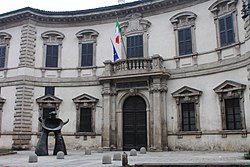
The Palazzo del Senato is a Baroque palace in central Milan. It now serves as the Archive of the State, and is located at 10 Via Senato.
Construction of the palace was begun in 1608 by cardinal Federico Borromeo, who wished to erect a Swiss seminary college; the site held ruins of ancient convent of Umiliate nuns. Design of the project was initially assigned to Fabio Mangone, but completed by Francesco Maria Richini. The latter architect solved the problem of the disparate registers of the collegio and the adjacent church, with a convex façade. It curves forward on the right so that the edge on that side matches the church. In 1786, it became the host of government offices of the Habsburg Austrian Empire. In 1797, the invading French sited the house of deputies of the Cisalpine Republic. In 1805 to 1814, when Milan was the capital of the Kingdom of Italy, the palace served as the Senate house. In front of the palace, stands a statue by Joan Miró.
141 m
The State Archives of Milan, based at the Palazzo del Senato, Via Senato n. 10, is the state institution responsible, by law, for the preservation of records from the offices of state bodies, as well as public bodies and private producers. Slowly formed through the agglomeration of the various archival poles spread throughout Austrian Milan between the end of the 18th and the first half of the 19th century, the State Archives finally found its home in the former Palazzo del Senato under the direction of Cesare Cantù in 1886. Having become a research and training center of excellence under the directorships of Luigi Fumi and Giovanni Vittani, the State Archives of Milan since 1945 continued its role as a preservation institution, adapting to the needs of the times and developing the School of Archival Studies, Palaeography and Diplomatics attached to the Institute.
The Milan State Archives, which currently covers 45 km of shelves and a storage space of 6,460 m2, preserves archives and collections containing records of political and religious institutions prior to Unification, such as the acts produced by the Sforza chancery or under the Spanish and Austrian governments. Following the outline prepared by the General Directorate of Archives, in addition to the documents produced before 1861, the State Archives collects and preserves the acts produced by the Italian state agencies reporting to Milan, such as the prefecture, the court and the Milanese police headquarters, as well as notarial acts from the local district notarial archives and those from the archives of the military districts. Finally, there is the miscellaneous archives subdivision, not falling under the previous chronological subdivision and consisting mainly of private or public archives.
Some of the most famous documents that the Archives preserve include the Cartola de accepto mundio, the oldest Italian parchment preserved in any Italian State Archives; the Codicetto di Lodi; autographed letters from Leonardo da Vinci, Charles V, Ludovico il Moro and Alessandro Volta; a valuable copy of the Napoleonic Code autographed by the emperor himself; and the minutes of the trial against Gaetano Bresci.

189 m
Villa Necchi Campiglio is a historic residence located at via Mozart, 14, Milan. It was built between 1932 and 1935 as an independent single-family house designed by Piero Portaluppi, an important Milanese Rationalist architect, and is surrounded by a large private garden with a tennis court and swimming pool. This was the second swimming pool ever to be built in Milan after the municipal one, and the first to be built on private land.
Among the personalities who were hosted there were Henry of Hesse, set designer for the Teatro alla Scala, who was housed during his stays in a room called the Prince's Room in his honor. There was also the Princess' Chamber, reserved for Princess Maria Gabriella of Savoy, a good friend of the Necchi sisters.

198 m
Book your tour near
Palazzo Serbelloni
→
The first floor has a Neoclassical hall, originally decorated by Giuliano Trabellesi. In 1943, air-raids destroyed extensive sections, including the famous library with its 75,000 books, and the frescoes by Traballesi.
References
Official Milan Tourism entry.
Book your tour near
Palazzo Serbelloni
Book Now
4.2
in partnership with
GetYourGuide.com
