

 English
 Français

The Old Vicarage, Wakefield
The Old Vicarage in Wakefield, West Yorkshire, England is a building dating from c. 1349. Located on Zetland Street, the building and surrounding car park are linked to a network of tunnels, believed to be used by non-conformists after the Act of Uniformity was passed in 1662.
The Old Vicarage is owned by the Wakefield County Conservative Association and is currently occupied by independent shops.
Nearby Places View Menu

159 m
Trinity Walk
Trinity Walk is a shopping centre in Wakefield, West Yorkshire. England. Opened on 6 May 2011, Wakefield Council describe it as "the most important City Centre development for more than 20 years."

172 m
Capture of Wakefield
The capture of Wakefield occurred during the First English Civil War when a Parliamentarian force attacked the Royalist garrison of Wakefield, Yorkshire. The Parliamentarians were outnumbered, having around 1,500 men under the command of Sir Thomas Fairfax, compared to the 3,000 led by George Goring in Wakefield. Despite being outnumbered, Parliamentarians successfully stormed the town, taking roughly 1,400 prisoners.
Around 800 Parliamentarians had been taken prisoner after being defeated at Seacroft Moor, and Fairfax plotted the capture of Wakefield to take prisoners of his own to exchange for his men. He marched his force from Leeds and split it in two to attack from different directions. After around two hours of fighting early in the morning of 21 May, 1643, Fairfax broke through into Wakefield. Goring, who had been in bed suffering from either illness or a hangover, rose and led a counterattack in his nightshirt, but to no avail and the town was captured. Fairfax gained the prisoners he needed and much ammunition. According to his own account, the Parliamentarians lost no more than seven men.
172 m
Wakefield Cathedral
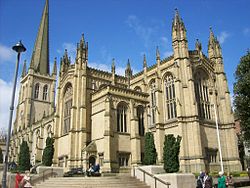
Wakefield Cathedral, or the Cathedral Church of All Saints in Wakefield, West Yorkshire, England, is a co-equal Anglican cathedral with Bradford and Ripon Cathedrals, in the Diocese of Leeds and a seat of the Bishop of Leeds. Originally the parish church, it has Anglo Saxon origins and, after enlargement and rebuilding, has the tallest spire in Yorkshire. Its 247-foot (75 m) spire is the tallest structure in the City of Wakefield. The cathedral was designated a Grade I listed building on 14 July 1953.

198 m
Elizabethan Gallery
The Elizabethan Gallery is a Grade II* listed historic building in the city centre of Wakefield, in West Yorkshire, England.
The building was constructed in 1598, as the Queen Elizabeth Grammar School, funded by the Savile family. It was soon extended to the north, and in 1895 was also extended to the south. The school moved in 1855 to a site on Northgate, and the building became the Wakefield Cathedral School. Wakefield Council purchased the building in 1979, and in 1981, the building began being used as an exhibition space for the city art gallery. More recently, it has been hired out as an event space.
The original part of the school is one storey high and six bays long. It is built of sandstone and has windows with mullions and transoms, and a stone slate roof with an original frame. In the south bay are carved the names of members of the Savile family, along with its coat of arms and an owl crest. The north extension is in a similar style, while the south wing features a Tudor arch doorway.
The building is now next to the Trinity Walk shopping centre, but is distinguished from it by its lawns and stone paving.