


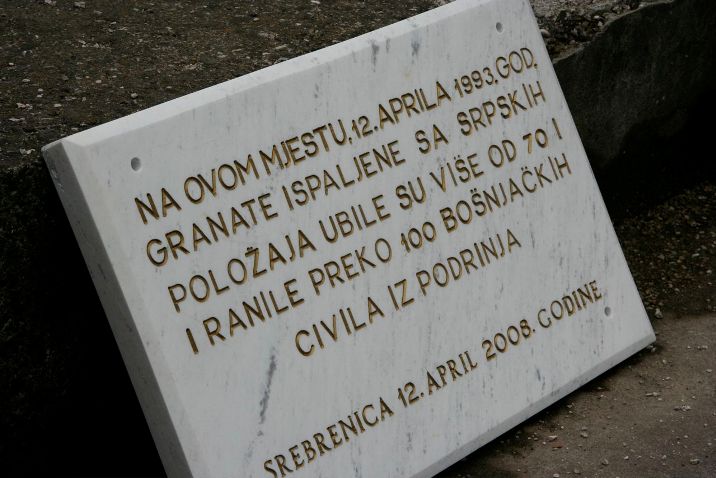
On 12 April 1993, the Army of Republika Srpska (VRS) launched an artillery attack against the town of Srebrenica. The attack left 56 dead (including 14 children killed on a school playground), and 73 seriously wounded. The attack followed the suspension of cease-fire talks, and only hours before NATO would implement a no-fly zone in accordance to an UN resolution.
Gallery

Sponsored
Location
1 explorer visited this place
0 m
The siege of Srebrenica was a three-year siege of the town of Srebrenica in eastern Bosnia and Herzegovina which lasted from April 1992 to July 1995 during the Bosnian War. Initially assaulted by the Yugoslav People's Army and the Serbian Volunteer Guard, the town was encircled by the Army of Republika Srpska in May 1992, starting a brutal siege which was to last for the majority of the Bosnian War. In June 1995, the commander of the Army of the Republic of Bosnia and Herzegovina in the enclave, Naser Orić, left Srebrenica and fled to the town of Tuzla. He was subsequently replaced by his deputy, Major Ramiz Bećirović.
In July 1995, Srebrenica fell to the combined forces of the Republika Srpska and numerous paramilitary formations which included hundreds of Greek and Russian volunteers in what was codenamed Operation Krivaja '95. The subsequent Srebrenica massacre of the town's male population led to the deaths of more than 8,000 Bosniak men and boys, and is considered the largest act of mass murder in Europe since the end of World War II. It was judged to have been a crime of genocide by international criminal courts. As a result, VRS General Radislav Krstić was found guilty by the International Criminal Tribunal for the former Yugoslavia of murder, persecution and aiding and abetting genocide, while VRS General Zdravko Tolimir was also convicted of genocide. Both men were sentenced to life imprisonment. One of the indictments against Ratko Mladić, the commander of the VRS during the war, is for the massacre in Srebrenica. The commander of Bosniak forces in the enclave, Naser Orić, was found guilty of failing to prevent the mistreatment of VRS prisoners held in Srebrenica between September 1992 and March 1993. His conviction was overturned in 2008.

0 m
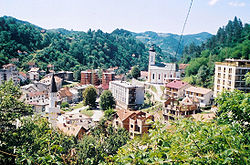
Srebrenica is a town and municipality in Republika Srpska, Bosnia and Herzegovina. It is a small mountain town, with its main industry being salt mining and a nearby spa.
During the Bosnian War in 1995, Srebrenica was the site of genocidal killing of more than 8,000 Bosniak men and boys, which was subsequently designated as an act of genocide by the ICTY and the International Court of Justice. It was perpetrated by units of the Bosnian Serb Army of Republika Srpska under Ratko Mladić, though the Serb paramilitary unit Scorpions also participated.
As of 2013, the town has a population of 2,607 inhabitants, while the municipality has 13,409 inhabitants. Before the war, the municipality's Bosniak population was 27,542 and the Serb population was 8,315. As of 2013, the equivalent figures were 7,248 Bosniaks and 6,028 Serbs.
266 m
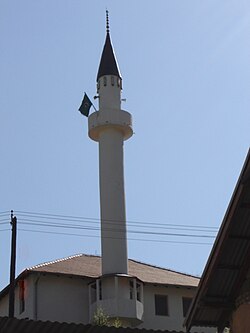
The White Mosque, also known as the Hajji Skenderbeg's Mosque, is a mosque located in the town of Srebrenica, in eastern Bosnia and Herzegovina.
514 m
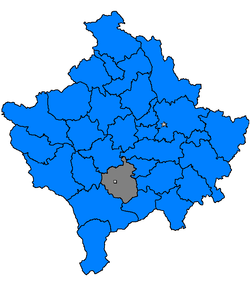
The Suva Reka massacre refers to the mass murder of Kosovo Albanian civilians committed by Serbian police officers on 26 March 1999 in Suva Reka, Kosovo, during the 1999 NATO bombings of Yugoslavia.

564 m
The Strebrenica Fortress is located in Srebrenica, Bosnia and Herzegovina. It dates back to medieval times and was still in use at the end of the 17th century. It is included in the list of National Monuments of Bosnia and Herzegovina.
VRS officials had previously told UNHCR representatives that unless the town surrendered within two days, the VRS would shell it.