

 English
 Français

St Salvator's College, St Andrews
St Salvator's College was a college of the University of St Andrews in St Andrews, Scotland. Founded in 1450, it is the oldest of the university's colleges. In 1747 it merged with St Leonard's College to form United College.
Nearby Places View Menu

19 m
St Salvator's Chapel
St Salvator's Chapel is one of two collegiate chapels belonging to the University of St Andrews, the other being St Leonard's Chapel, situated in the grounds of the adjacent St Leonard's School. The chapel, also known as St Salvator's College Church, was founded in 1450, by Bishop James Kennedy, built in the Late Gothic architectural style, and refurbished in the 1680s, 1860s and throughout the 20th century. It is currently the chapel of the United college as well as being the major university chapel.
Students and members of the public regularly attend its numerous services, including twice weekly Choral Evensong and, most popularly, Sunday services. The Sunday services are followed by the famous pier walk, in which students walk to the pier and back in academic procession. Other services are held occasionally to mark graduations and other such occasions, and the chapel also hosts wedding ceremonies for many of the university's alumni. The chapel has its own choir, The St Salvator's Chapel Choir, which sings at most services.
The name St Salvator is a reference to Jesus Christ and the former college for which the chapel was built founded by Bishop Kennedy. St Salvator's is the only University Chapel in Scotland with a full ring of six bells suitable for change ringing. Four new bells, Agnes, Margaret, George, and Annie, were added to Katherine and Elizabeth (the existing bells) as part of the university's 600th anniversary celebrations in 2010, also marking the 550th anniversary of the chapel.

51 m
Younger Hall
Younger Hall is the venue for graduation ceremonies and other large-scale university and some public events in St Andrews, Scotland. Its main hall seats almost 1000 people and is mainly used for lectures and author talks.

125 m
St Andrews
St Andrews (Latin: S. Andrea(s); Scots: Saunt Aundraes; Scottish Gaelic: Cill Rìmhinn, pronounced [kʰʲɪʎˈrˠiː.ɪɲ]) is a town on the east coast of Fife in Scotland, 10 miles (16 kilometres) southeast of Dundee and 30 miles (50 kilometres) northeast of Edinburgh. St Andrews had a recorded population of 16,800 as of 2011, making it Fife's fourth-largest settlement and the 45th most populous settlement in Scotland.
The town is named after Saint Andrew the Apostle. The settlement grew to the west of St Andrews Cathedral, with the southern side of the Scores to the north and the Kinness Burn to the south. The burgh soon became the ecclesiastical capital of Scotland, a position which was held until the Scottish Reformation. The famous cathedral, the largest in Scotland, now lies in ruins. St Andrews is also known globally as the "home of golf". This is in part because of The Royal and Ancient Golf Club of St Andrews, founded in 1754, which until 2004 exercised legislative authority over the game worldwide (except in the United States and Mexico). The Old Course of St Andrews Links (acquired by the town in 1894) is the most frequent venue for The Open Championship.
It is home to the University of St Andrews, the third oldest university in the English-speaking world and the oldest in Scotland. It was ranked as the best university in the UK by the 2022 Good University Guide, which is published by The Times and The Sunday Times. According to other rankings, it is ranked as one of the best universities in the United Kingdom. The Martyrs Memorial, erected to the honour of Patrick Hamilton, George Wishart, and other martyrs of the Reformation epoch, stands at the west end of the Scores on a cliff overlooking the sea. The civil parish has a population of 18,421 (in 2011). The town also contains numerous museums, a botanic garden and an aquarium.
166 m
St Salvator's Hall
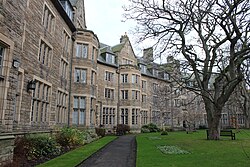
St Salvator's Hall (affectionately known as Sallies) is a student hall of residence at the University of St Andrews. It lies close to the quadrangle of the United College, St Andrews and St Salvator's Chapel, a foundation which was endowed by King James II of Scotland. The Hall is in an area between North Street and The Scores. Architecturally, it has been described as a "rambling Gothic dormitory".
The stained glass windows of the hall and the paintings in its oak-panelled dining room feature associates and benefactors of the University of St Andrews, such as David Beaton, James Graham, 1st Marquess of Montrose and Edward Harkness. The hall has had a history of health disasters. These include an incident of mass poisoning with arsenic trioxide in January 1945 and the contamination of the hall's water supply with Legionella bacteria in November 2020.