Location Image

Ripon Opera House

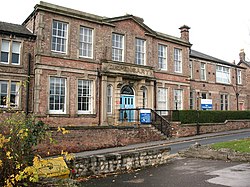
Ripon Opera House is a historic building in Ripon, a city in North Yorkshire, in England. In 1834, the founders of Ripon's subscription library constructed the Public Rooms, to provide space for events. In 1886, the larger Victoria Hall was erected to the rear, at right angles, to a design by George Mallinson. It was more lavishly decorated than the older Public Rooms, and cost £2,000 to construct. In about 1912, the hall was converted into a cinema named the "Opera House", although it continued to host live events. It offered 800 seats on two levels. The cinema closed in about 1960, with the hall being converted into a factory, and the public rooms into government offices. The factory burned down around 1980, and the offices were later converted into the Sigma Antiques shop. The surviving building is constructed of whitewashed brick, with bracketed eaves and a slate roof. There are two storeys and five bays, and a single-bay extension to the right of the same height with three storeys. In the centre are three round arches, the middle one containing a doorway and the others with windows, and the other windows are sash windows. On the extension is a recessed doorway with an oblong fanlight. It has been grade II listed since 1977.

Nearby Places View Menu
Location Image
126 m

Ripon Town Hall

Ripon Town Hall is a municipal building in the Market Place, Ripon, North Yorkshire, England. The structure, which was the headquarters of Ripon Borough Council, is a Grade II* listed building.
Location Image
134 m

The Wakeman's House

The Wakeman's House is a historic building in Ripon, a city in Yorkshire, in England. The building was constructed as a house in the 16th or early 17th century, facing onto High Skellgate. In about 1600, the entrance was altered to face onto the Market Square, and over time most of the building was demolished, leaving one wing standing. It was traditionally considered to have been the house of Hugh Ripley, the last Wakeman of Ripon, who in 1604 became the city's first mayor. In 1917, the remaining wing was under threat of demolition, but was purchased by the city council and restored, with a kitchen added at the rear. The council opened the building as a museum, and stripped the plaster from the front, to expose the timber frame. The building was Grade II* listed in 1949. After the museum closed, the building served successively as a tea shop, a tourist information centre, the offices of the Ripon Improvement Trust, a dress shop, and then a tea shop again. In 2000, the kitchen was demolished, and public toilets were constructed on the site. The building has two main storeys and an attic. It is timber-framed throughout, with a stone slate roof. The front of the building has oriel windows on both floors, while the attic has a window in its gable end. Inside, the staircase has balusters with a pattern of circles and rectangles. A local tradition claims that the building is haunted by the ghost of Hugh Ripley, even though he never lived in the building. When it reopened in the 1920s after restoration, there was a ceremony at which the city hornblower performed. Several members of the crowd claimed to have seen the ghost at an upstairs window.
Location Image
150 m

Ripon Community Hospital

Ripon Community Hospital is a longstanding NHS community healthcare facility located in the cathedral city of Ripon, North Yorkshire, England. The hospital serves residents in Ripon and surrounding rural areas, providing a range of outpatient services, minor injury treatment, and rehabilitation care.
Location Image
152 m

Black Swan, Ripon

The Black Swan is a historic pub in Ripon, a city in North Yorkshire, in England. The building lies on Westgate, in the city centre. It is uncertain when it was built, but it was constructed in or before the mid 19th century. The roof was replaced in the 20th century, and the building was grade II listed in 1970. Two stories of ghosts are associated with the pub: one of a blacksmith, said to have had a smithy to the rear of the building; and the other of an unseen ghost said to apply suffocating pressure to guests in bed. The pub is stuccoed, and has wooden gutter brackets and a pantile roof. There are two storeys and three bays. The right bay has a carriage entry, over which is a canted oriel window. The doorway has a plain surround, panelled reveals, an oblong fanlight and a dentilled cornice on corbels, and the windows are sashes. Inside, it has a large front bar with an old fireplace, then a smaller back bar, both with access to an L-shaped serving area; then steep steps down to a further seating area with dartboards, and also toilets.