


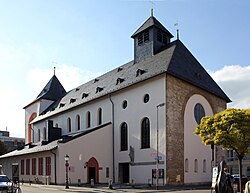
L’église Saint-Étienne a plus de mille ans, puisque c’est en l’an 990 que l'archevêque de Mayence Willigis, qui était en même temps grand chancelier du Saint-Empire romain germanique, fit construire une collégiale de religieux qui devait servir d’oratoire impérial. Le fondateur de la cathédrale fut inhumé en cet endroit en 1011.
Gallery


Sponsored
Location
1 explorer visited this place

0 m
The Collegiate Church of St. Stephan, known in German as St. Stephan zu Mainz, is a Gothic hall collegiate church located in the German city of Mainz. It is known for windows created by Marc Chagall.

189 m
The Osteiner Hof is one of several Baroque-era palatial mansions along Schillerplatz square in the German city of Mainz. The mansion, along the southern edge of the square, was built in 1747-1752 by architect-soldier Johann Valentin Thomann for Franz Wolfgang Damian von Ostein, brother of Johann Friedrich Karl von Ostein, who was prince-bishop of Mainz at that time.
Characteristic features for this building are the three round protrusions at the front entrance and on the two corners. The building is lavishly decorated; for instance, the windows are framed by rococo-style cartouches symbolising the elements of air, earth and water. The classical gods Diana and Mars are shown on the cartouches framing the balcony doors.
The von Osteins, a dynasty of counts, were not able to make use of the mansion for very long. After the left bank of the Rhine was occupied by French Revolutionary armies, the mansion was appropriated by the state, and in 1798 it became the seat of a newly created département of France, Mont-Tonnerre.
The building continued to be used as a seat of government after the Napoleonic era, even gaining the nickname Gouvernement during the years 1854-1859, while emperor-to-be Wilhelm I was serving as military governor of Mainz. During the early days of the Franco-Prussian War, the Osteiner Hof served as military headquarters of a Prussian field marshal, Prince Frederick Charles of Prussia.
In 1914, then-military governor General Hugo von Kathen announced the start of World War I to the Mainz populace from the balcony of the Osteiner Hof. The mansion was destroyed by fire during World War II, but was restored in 1947-1948. From 1958 until 2014, the Osteiner Hof was in use by the Bundeswehr as military headquarters and officers' mess.
The Osteiner Hof plays an important part in the local carnival traditions. Every year, on 11 November at 11 past 11, the start of the carnival season is proclaimed from the balcony of the mansion.

254 m
The Bassenheimer Hof is an historic building in Mainz, western Germany.
At present the large structure is the seat of the Ministry of the Interior and Sports of the federal state of Rhineland-Palatinate.
399 m
St. John's Church is located beneath Mainz Cathedral in the historical center of Mainz, Germany. This 1100-year-old church was the first episcopal see of the Bishop of Mainz. It is the oldest church in Mainz, the oldest cathedral in the Germany of today and the only preserved cathedral building from late Carolingian and early Ottonian time in Germany.
St. John's Church is predominantly Carolingian in style, but later exterior additions over many centuries have resulted in the appearance of various architectural influences seen today. It comprises three naves and stands under the patronage of John the Baptist today. It can be assumed that the church was dedicated initially to Martin of Tours since Martin is the Patron saint of the Roman Catholic Diocese of Mainz, then to St. Salvator, consecrated in 911 by Archbishop Hatto I and served as the cathedral for the Bishop of Mainz until the appointment of Willigis as Archbishop of Mainz in 975. It is documented that archbishop Erkanbald was buried in this first cathedral. In 2019, a sarcophagus was opened to gain more information on the early history of the diocese of Mainz. Whether it concerns the remains of cleric Erkanbald, buried in 1021, is investigated since then said research director Guido Faccani.

420 m
The Gutenberg Monument is a bronze statue monument of Johannes Gutenberg standing atop a plinth with bas-reliefs, designed by Bertel Thorvaldsen and erected in Mainz in 1837.
La date exacte de construction de la basilique à double absidioles et de style otto-préroman est inconnue. L'église Saint-Étienne était (selon l’expression de Willigis) la « couronne de Mayence » : en effet, l'étymologie grecque (Στέφανος Stéphanos) d'Étienne signifie couronné.
Book your tour near
Église Saint-Étienne de Mayence
Book Now
4.0
in partnership with
GetYourGuide.com