

 English
 Français
Monkland and Kirkintilloch Railway
The Monkland and Kirkintilloch Railway (M&KR) was an early mineral railway running from a colliery at Monklands to the Forth and Clyde Canal at Kirkintilloch, Scotland. It was the first railway to use a rail ferry, the first public railway in Scotland, and the first in Scotland to use locomotive power successfully, and it had a great influence on the successful development of the Lanarkshire iron industry. It opened in 1826. It was built to enable the cheaper transport of coal to market, breaking the monopoly of the Monkland Canal. It connected with the Forth and Clyde Canal at Kirkintilloch, giving onward access not only to Glasgow, but to Edinburgh as well. The development of good ironstone deposits in the Coatbridge area made the railway successful, and the ironstone pits depended at first on the railway. Horse traction was used at first, but steam locomotive operation was later introduced: the first successful such use in Scotland. Passengers were later carried, and briefly the M&KR formed a section of the principal passenger route between Edinburgh and Glasgow. In 1848 the company merged with two adjoining railway lines to become the Monkland Railways; which in turn were absorbed by the Edinburgh and Glasgow Railway. A short length of the original route remains in use in the Coatbridge area.
Nearby Places View Menu

Woodilee Hospital
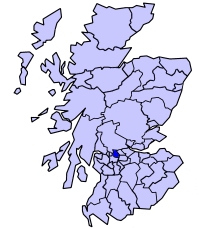
Strathkelvin
Woodilee Village
