

 English
 Français
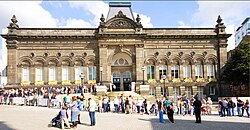
Leeds City Museum
Leeds City Museum, established in 1819, is a museum in Leeds, West Yorkshire, England. Since 2008 it has been housed in the former Mechanics' Institute built by Cuthbert Brodrick, in Cookridge Street (now Millennium Square). It is one of eight sites in the Leeds Museums & Galleries group. Special exhibitions are hosted alongside a collection of displays from the Leeds Archive.
Nearby Places View Menu
0 m
Leeds Mechanics' Institute
Leeds Mechanics' Institute was a mechanics' institute founded in 1824 in Leeds, West Yorkshire, England, and is one of the predecessor institutions of Leeds Beckett University and Leeds Arts University.

43 m
O2 Academy Leeds
The O2 Academy Leeds (formerly known as the Town and Country Club) is a music venue situated in Leeds, West Yorkshire, England. It is run by the Academy Music Group, which has other music venues around the UK. The Academy was nominated for the TPi Awards 2010 for the country's favourite venue.
101 m
Northern Film School
The Northern Film School is part of the Leeds Beckett University Leeds School of Arts. It is one of the largest full-time film schools in the UK, offering both bachelor's and master's degrees, and is situated in the city centre of Leeds. School was established in 1970 in Leeds, West Yorkshire, England.

101 m
Nesyamun
Nesyamun, also known as Natsef-Amun or The Leeds Mummy, was an ancient Egyptian priest who lived during the Twentieth Dynasty c. 1100 BC. He was a senior member of the temple administration in the Karnak temple complex and held various titles including "god's father of Montu" and "scribe of Montu", and was responsible for presenting the daily food offerings to the gods and tallying the cattle of the Karnak temple estates. Nothing is known about his family.
His body was discovered in the early 1820s during excavations of the Deir el-Bahari causeway by Giuseppe Passalacqua. He was shipped to Europe and sold several times before being purchased for the Leeds Philosophical and Literary Society's museum in Leeds, England. In 1824 his coffin and mummy was the subject of one of the earliest scientific investigations of an Egyptian mummy. His remains are now held in the collection of the Leeds City Museum. Study of his coffin and mummy cover found them to be of high quality. Nesyamun was the only one of the museum's mummies to remain intact following the 1941 Leeds Blitz, although his mummy cover sustained major damage. From the 1930s onward he has undergone various forms of testing which has revealed his general state of health and that he died aged between 50 and 60 years. In 2020, his mummified vocal tract was modelled using CT scan data, allowing it to produce a single sound; the study attracted criticism for its ethics and research value.