


The Forest Hills School in Franklin, Tennessee was built in 1907. Along with Liberty School and Liberty Hill School, it is one of the three best surviving examples in Williamson County of one room schoolhouses built during 1900–1920. While most of these schools have been lost, they once provided the majority of public education in the county.
Gallery


Sponsored
Location
1 explorer visited this place
1.4 km
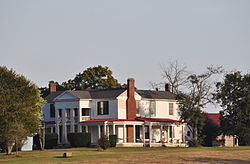
The Claiborne Kinnard House also known as Windermere is a historic home in Franklin, Tennessee, built in 1887 on land that was once the eastern flank of the 1864 Battle of Franklin. A 1988 study of Williamson County historical resources assessed that this house was one of the "best two-story vernacular I-House examples" in the county; the others highly rated were the William King House, the Alpheus Truett House, the Thomas Brown House, the Beverly Toon House, and the Stokely Davis House.
The house was listed on the National Register of Historic Places in 1988. It is located in Franklin at the corner of Lewisburg Pike and Carnton Lane.
The land was originally owned by John McGavock who lived at nearby Carnton Plantation. He willed 100 acres to his daughter Harriet and her husband, George L. Cowan who built the house in 1887. It had various unofficial names in the 20th century but the earliest was "Windermere" which is the name preferred by the 21st century owners. In 1915 the house and 215 acres was sold to Claiborne H. Kinnard. When Kinnard died in 1966, the property went to his son Claiborne H. Kinnard Jr. The Kinnard family built a large swimming pool on the property, a business venture known as "Willow Plunge" which was very popular and remained in business from 1924 to 1967.
2.6 km
The John Hunter House, also known as McCullough House, near Franklin, Tennessee is an Italianate style house that was built in 1875. It was listed on the National Register of Historic Places in 1988.
The NRHP eligibility of this property and others was covered in a 1988 study of Williamson County historical resources. The house was one of relatively few fine brick residences built in Williamson County, Tennessee, besides in Franklin, that were built from 1865 to 1937. Another one, also in Italianate style, is the Andrew Vaughn House, also NRHP-listed. Both "feature arched fenestration and ornate eaves" and had had few changes since, as of the 1988 study.
The house was built or has other significance in c. 1875, c. 1890, and c. 1910.
The NRHP listing was for an area of 2.8 acres with just one contributing building.

5.7 km
Williamson County is a county in the U.S. state of Tennessee. As of the 2020 United States census, the population was 247,726. The county seat is Franklin, and the county is located in Middle Tennessee. The county is named after Hugh Williamson, a North Carolina politician who signed the U.S. Constitution. Williamson County is part of the Nashville-Davidson–Murfreesboro–Franklin, TN Metropolitan Statistical Area. In the 19th century, tobacco and hemp were cultivated here, and planters also raised warm-blooded livestock, including horses and cattle.
Williamson County is ranked as the wealthiest county in Tennessee, as well as among the wealthiest counties in the country.

5.7 km
The Boyd–Wilson Farm is a 157-acre historic district in Franklin, Tennessee, United States. The circa 1840 farm includes an I-house.
The district was listed on the National Register of Historic Places in 1996. When listed, it included six contributing buildings, two contributing structures, one contributing site and two non-contributing buildings.
The farm's west edge is the West Harpeth River. The property includes the historic Boyd Mill Ruins.
The farmhouse's north, two-story facade was built c.1884 and is of heavy braced frame construction. It has a central hallway and chimneys at its gable ends in what is called an I-house. The chimneys, originally limestone, were modified c.1920 to include brick. It has a two-story portico with four square columns built in 1976 which replaced a one-story portico from c.1884.
It was deemed notable as "one of the few historic farms in Williamson County to retain its agricultural integrity from a period in the county's history when agriculture was the basis of prosperity."
It is a designated Century Farm. Historic notability of properties of this type was covered in a 1994 study of historic family farms in Middle Tennessee.
6.1 km
The John Neely House is a property in Thompsons Station, Tennessee dating from c. 1810 that was listed on the National Register of Historic Places in 1988. The property has also been known as Hilltop Manor.
The NRHP eligibility of the property was addressed in a 1988 study of Williamson County historical resources.
It was listed on the National Register of Historic Places in 1988. The property is denoted WM-670 among Williamson County's historic resources.