

 English
 Français
Lingfield Point
Lingfield Point is a British business park in Darlington, County Durham created on a historic industrial site previously home to Europe's largest wool manufacturing plant developed by Patons & Baldwins.
Nearby Places View Menu
1.1 km
Eastbourne, County Durham
'Eastbourne' is a former village in the borough of Darlington and the ceremonial county of County Durham, England. It is situated immediately to the east of the town centre of Darlington of which it is now an area.

1.2 km
Brick Train
The Brick Train is a brick sculpture located on the outskirts of the town of Darlington, in the English county of Durham. The sculpture was created by David Mach in 1997 to celebrate the town's railway heritage, and is modelled on the steam locomotive Mallard, which set a UK rail speed record of 126 miles per hour (203 km/h) in 1938. The locomotive is depicted as if just having exited a tunnel, with the billowing smoke typical of such an exit.
The sculpture is situated adjacent to Morrisons supermarket in the Morton Park shopping area to the east of Darlington town and in the civil parish of Morton Palms. A total of 185,000 Accrington Nori bricks were used in the sculpture's construction, and it is 7 metres (23 ft) high and 39.6 metres (130 ft) long, covering an area of 600 square metres (6,500 sq ft). It is hollow inside and special bricks provide gaps that enable bats to fly inside and roost. The sculpture is visible from the nearby A66 road, and was officially unveiled by Lord Palumbo of Walbrook on 23 June 1997.
The work cost £760,000, which was provided by the National Lottery Heritage Fund along with smaller contributions from Darlington Borough Council, Northern Arts and Morrisons.

1.2 km
St Aidan's Church of England Academy
St Aidan's Church of England Academy is a coeducational secondary school with academy status, in Darlington, County Durham, England. There are 550 pupils enrolled at the Academy for 2023.
1.5 km
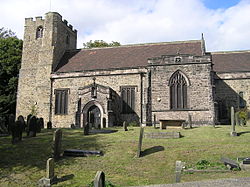
Haughton-le-Skerne
Haughton-le-Skerne is a village in the borough of Darlington in the ceremonial county of Durham, England. It is situated in the north east of Darlington. The village lies to the west of the River Skerne.
At the centre of the village green, is the main road towards Darlington town centre going across the river, south of the church. There used to be a linen mill on the riverbank on the east side of the village. Part of the mill leat can still be seen today.
St Andrew's Church at the west end of the village green is the oldest church in Darlington, circa 1125. Some of the stones may have originated in a previous church on the same site.
Parts of the existing rectory have monastic ruins built into the foundation and some inner walls, speculated to be evidence of an earlier building on this site.
On the north side of Haughton-le-Skerne, a turnpike led over the river to the ports on the Tees estuary, carrying traffic including salt from the Bishop's salt mines.
Haughton-le-Skerne is now connected to a large suburb of Darlington, with areas including Springfield and Whinfield.
The community was referred to in the ITV series Downton Abbey as it was the location where Mrs. Beryl Patmore (Lesley Nicol) would find a cottage which would serve as a boarding house, and when she retired, would serve as her home for her retirement days.
John Wrightson (1840-1916), founder of Downton Agricultural College and great grandfather of Downton writer Julian Fellowes was born in the village.