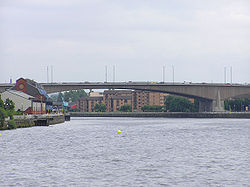
Vinegarhill was a location in Glasgow, Scotland, that served as a residence and place of business for travelling communities from all over the United Kingdom and beyond. All types of travellers resided there. The site of Vinegarhill, in the old weaving village of Camlachie in the east end of Glasgow, is now occupied by the Forge Retail Park. There is some debate as to why the area was referred to as Vinegarhill. Perhaps the most likely reason is that a firm called D. King & Co. carried out vinegar production at Camlachie from 1837 to 1860. In the 1870s, Glasgow councillors decided that the carnival and circus for Glasgow Fair, hitherto located in the Saltmarket and Glasgow Green, had to be relocated, so they moved them first to Crownpoint and then to Vinegarhill. It then became the main site for the travellers associated with the annual fair. The postal address of East Vinegarhill was 917 Gallowgate, and the voter's roll from 1928 to 1930 shows that 190 people were registered to vote at this address.

Nearby Places View Menu
Location Image
167 m

Camlachie

Camlachie (; Scottish Gaelic: Camadh Làthaich) is an area of Glasgow in Scotland, located in the East End of the city, between Dennistoun to the north, and Bridgeton to the south. Formerly a weaving village on the Camlachie Burn, it then developed as an important industrial suburb from the late 19th century, only to almost entirely disappear from the landscape when those industries declined a century later. It gave its name to the former constituency of the United Kingdom Parliament, Glasgow Camlachie which existed between 1885 and 1955. In the 21st century, much of the historic Camlachie territory is occupied by the Forge Retail Park (part of The Forge Shopping Centre complex which stretches west from its main site at Parkhead and was built on the site of the William Beardmore and Company steel forge, the area's major employer until its closure in 1983). Other streets which were traditionally part of Camlachie have become more associated with the Barrowfield and Gallowgate neighbourhoods following several redevelopments which caused the loss of most of the older buildings in the area and consequently its integrity as a defined district of the city.
Location Image
210 m

Greencity Wholefoods

Greencity Wholefoods is a worker co-operative wholefoods wholesaler in Glasgow, Scotland. The co-operative was founded in 1978 in Hillington, in the outskirts of Glasgow before moving in 1983 to its current location in Dennistoun in the city's East End. In 2019 the co-operative reported an annual turnover of £7.7 million and has 54 employee-members. As a worker co-operative the business is directly owned and controlled by its workers through a directly elected management committee and quarterly general meetings. The co-operative operates a flat wage structure, with every member paid the same hourly wage, alongside a flat management structure and a system of rotating the co-operative's directly elected managers. Greencity has many similarities with Suma, a worker co-operative in West Yorkshire, and stocks many Suma brand products. The co-operative delivers goods across Scotland, except for the Highlands and Islands which are covered by Greencity's sister co-operative Highland Wholefoods Workers Co-operative which Greencity helped establish in 1989.
Location Image
331 m

A728 road

The A728 is a route number in Glasgow, Scotland applied to two connected roads. The eastern branch, known as the Glasgow East End Regeneration Route runs from Polmadie to the Forge Shopping Centre in Camlachie in the east of the city. The first phase was opened in 2011 with the second phase opened in mid-2012; these two phases are officially known as the A728 Clyde Gateway. An extension to junction 13 of the M8, which is also the terminus of the M80, was planned as well, for construction in 2018. After delay, it was scrapped in 2021 due to climate concerns. The western branch of the route runs from the Albert Bridge near the city centre, where it meets the A8 and A74, and converges with the other branch near Toryglen Park in Polmadie. Both branches continue along the same road south towards King's Park.
Location Image
336 m

Glasgow Inner Ring Road

The Glasgow Inner Ring Road is a partially completed ring road encircling the city centre of Glasgow, Scotland. Its construction began in 1965, and half of its length was completed by 1972, forming part of the M8 motorway, but no further construction was made and the remaining plans were formally abandoned in 1980. After 30 years, a route following roughly the southern section of the proposals was created as the new M74.