

 English
 Français
Bathgate Academy
Bathgate Academy is a mixed secondary school in Bathgate, West Lothian, Scotland, also serving the nearby town of Blackburn.
Nearby Places View Menu
333 m
Boghall
Boghall is a Council Estate built in the early 1960s in West Lothian, Scotland just to the east of Bathgate.
Boghall has a range of amenities including a community centre, post office, 3 Corner Shops, a Scotmid supermarket, pharmacy, and a chip shop. Boghall is also home to Boghall Butchers which has won many awards for its pies and other foods. There are also 5 play parks around Boghall including Kirkton park, a community park with large green areas, a band stand, and a bowling/tennis club. Party in the park, a small local festival, is held here each year in September. In the middle of the estate is the Boghall Parish Church of Scotland, which offers weekly worship as well as various activities during the week in the Church hall. Boghall is found just on Puir wives' brae, which is part of the Bathgate Hills. Just outside of Boghall is the Pyramids business park along with a Toby Carvery, a Premier Inn hotel, and a petrol station, all of which local people consider to be in Boghall.
718 m
St Mary's Academy, Bathgate
St Mary's Academy was a Roman Catholic High School located in the eastern part of the town of Bathgate, West Lothian in Scotland. It was a state funded school for older children which drew its pupil roll from most of the towns in West Lothian. The motto was 'Animo et Fide' which translates from Latin as Courageously and Faithfully. The school was located on Edinburgh Road (A89).
758 m
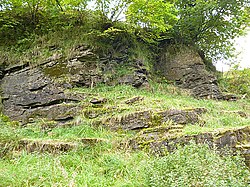
East Kirkton Quarry
East Kirkton Quarry, or simply East Kirkton, is a former limestone quarry in West Lothian, Scotland, now a renowned fossil site. The quarry is known for terrestrial and freshwater fossils up to 341 million years old, from the Viséan stage of the Mississippian subperiod (Early Carboniferous Period). The quarry is a 200-meter-long (~650 ft) depression located in the town of Bathgate. Geographically, it sits at the Bathgate Hills near the center of the Midland Valley, a fossil-rich region of southeast Scotland. The site is dominated by volcanic tuff, limestone, and silica deposits of large freshwater lakes associated with hot springs and local basaltic (high-iron) volcanism. Three geological intervals are exposed: the East Kirkton Limestone (oldest), Little Cliff Shale (middle), and Geikie Tuff (youngest).
The East Kirkton Limestone in particular has produced numerous well-preserved fossils of tetrapods (four-limbed vertebrates) and arthropods (multi-legged chitinous invertebrates like millipedes and arachnids). East Kirkton had been ignored by paleontologists since the 1840s, but Scottish fossil collector Stan Wood managed to procure the land in 1985, sparking a rush of scientific interest. New species from East Kirkton have been named on a regular basis since 1990, and nearly all of these species have been found nowhere else. Notable discoveries include Westlothiana (one of the most reptile-like Mississippian tetrapods), Balanerpeton (a common early representative of amphibians in the group Temnospondyli), and Pulmonoscorpius (the largest known terrestrial scorpion). The East Kirkton area represents an unconventional environment: dry woodlands and mineral-rich lakes nestled among volcanic cinder cones. Aquatic animals, though not uncommon, are less diverse than those found in the swampy coal forests and coastal sediments prevalent at other Scottish Carboniferous fossil sites. The prevalence of terrestrial organisms represents a broader trend of decreasing reliance on an amphibious lifestyle during the Carboniferous Period.

878 m
Pyramids (Bathgate)
The Pyramids are a land sculpture alongside the M8 motorway at Bathgate.
Originally named the "Sawtooth Ramps", it was sponsored by Motorola and formed part of the M8 Art Project. The sculpture was created by artist Patricia Leighton in 1993. It is 1,000 feet (300 m) long and consists of seven 36-foot (11 m) high ramps made of earth and seeded with grass. The artist based the design on local geographic features (drumlins) and the shape of the surrounding bings. Sheep are grazed on the structure which keeps the grass short. The pyramidal shape of the sculpture gave rise to the name of the nearby Pyramids Business Park.