


The Kangson enrichment site is the name given to a suspected uranium enrichment site located in Chollima-guyok, just outside of Pyongyang, North Korea, along the Pyongyang-Nampo Expressway.
Location
2.6 km
Taep'yŏng station is railway station in Taep'yŏng-ri, Man'gyŏngdae-guyŏk, P'yŏngyang, North Korea, on the P'yŏngnam Line of the Korean State Railway. The station is on the single-track mainline, serving as a halt for passenger trains.
The station was opened, along with the rest of the mainline of the P'yŏngnam Line, on 16 October 1910 by the Chosen Government Railway.
2.7 km
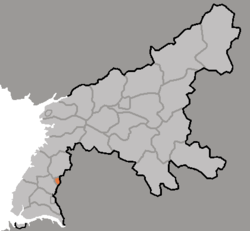
Ch'ŏllima is a kuyŏk in Namp'o Special City, North Korea. Prior to 2004, it was Ch'ŏllima-kuyok, a district of northeastern Namp'o Directly Governed City. Following the demotion of Namp'o in 2004, Ch'ŏllima became an independent county. The region was part of Kangsŏ county in 1952, and was entered into Taean city; when Taean was demoted to county in 1983, it became part of Namp'o Special City.
4.2 km
Kangsŏn station is a major railway station used by passenger and freight trains in Kangch'ŏl-dong, Ch'ŏllima-guyŏk, Namp'o Special City, North Korea, on the P'yŏngnam Line of the Korean State Railway. It is also the starting point of the freight-only Chamjilli Line.

5.1 km
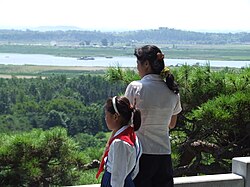
The Ch'ŏllima Steel Complex in Kangch'ŏl-dong, Ch'ŏllima-guyŏk, Namp'o is one of North Korea's largest steel mills with an annual production capacity in the millions of tons. Originally opened during the Japanese colonial era as the Kangsŏn Steel Works, it was nationalised after the partition of Korea and has since been expanded several times.
Currently, there are facilities for the production of steel and other alloys, steel rods, pipes and other metal products, and a facility for the production of large forgings and castings, along with a test and analysis centre. The production facility is equipped with electric furnaces, crushing and rolling mills, 6- and 10,000 tonne presses, oxygen separators and continuous mills. The complex also features metallurgical academies, cultural centres, childcare facilities, clinics, nightclubs and nursing homes. The complex was awarded the Order of Kim Il Sung.
The facility is served by the Korean State Railway via Kangsŏn on the P'yŏngnam Line with extensive trackage within the complex.
Kim Jong Il visited the site in 2008 or Juche 97 according to the North Korean Calendar which starts on 1912 following the birth of Kim Il Sung.
5.7 km
Mangyongdae is a neighborhood in Mangyongdae-guyok, Pyongyang, North Korea. North Korean propaganda claims that Mangyongdae is the birthplace of North Korean leader Kim Il Sung, although in his memoirs he wrote that he had been born in the nearby neighborhood of Chilgol. Mangyongdae is where his father Kim Hyong-jik was from, and where Kim Il Sung spent his childhood.
Mangyongdae has been designated as a historic site since 1947, and is listed as a Revolutionary Site. Original structures at the site have been replaced with replicas.
Mangyongdae has since been incorporated to the city of Pyongyang. The Football at the Mangyongdae Prize Sports Games and Mangyongdae Prize International Marathon are both named after the area.