

 English
 Français

All Saints' Church, St Andrews
All Saints' Church, St Andrews, is in North Castle Street, St Andrews, Fife, Scotland (grid reference NO512168). It is an active Scottish Episcopal Church and is a Category A listed building. The first church building on the site was a temporary iron church made by Spiers of Glasgow in May 1903, which provided seating for 150 people. The foundation stone for a more permanent building was laid on 11 March 1907. In that year a chancel and belltower designed by the Chester architect John Douglas were built. The iron structure was moved to form the nave of the church. In June 1920 the foundation stone of a new nave was laid. This was designed by Paul Waterhouse and consecrated on 1 November 1923. The current rector is Alasdair Coles.
Nearby Places View Menu

107 m
St Andrews Castle
St Andrews Castle is a ruin located in the coastal Royal Burgh of St Andrews in Fife, Scotland. The castle sits on a rocky promontory overlooking a small beach called Castle Sands and the adjoining North Sea. There has been a castle standing at the site since the times of Bishop Roger (1189–1202), son of the Earl of Leicester. It housed the burgh’s wealthy and powerful bishops while St Andrews served as the ecclesiastical centre of Scotland during the years before the Protestant Reformation. In their Latin charters, the Archbishops of St Andrews wrote of the castle as their palace, signing, "apud Palatium nostrum."
The castle's grounds are now maintained by Historic Environment Scotland as a scheduled monument. The site is entered through a visitor centre with displays on its history. Some of the best surviving carved fragments from the castle are displayed in the centre, which also has a shop.

116 m
Deans Court
Deans Court is a student hall of residence at the University of St Andrews originating from the 12th century, thus, arguably, the oldest dwelling house in the town of St Andrews, Scotland. It stands at the east-end of St Andrews, where North street and South street converge. The entrance of the courtyard opens up to the ancient, ruined, St Andrews cathedral. The Hall is open exclusively to postgraduates, and comprises the main building and four annexes, two on North Street, two on South Street. Current residents are affectionately known as Deans Courtiers, Deans Courtesans, or Deans Beans.
132 m
St Salvator's Hall
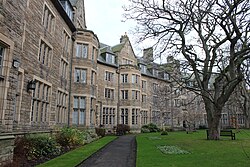
St Salvator's Hall (affectionately known as Sallies) is a student hall of residence at the University of St Andrews. It lies close to the quadrangle of the United College, St Andrews and St Salvator's Chapel, a foundation which was endowed by King James II of Scotland. The Hall is in an area between North Street and The Scores. Architecturally, it has been described as a "rambling Gothic dormitory".
The stained glass windows of the hall and the paintings in its oak-panelled dining room feature associates and benefactors of the University of St Andrews, such as David Beaton, James Graham, 1st Marquess of Montrose and Edward Harkness. The hall has had a history of health disasters. These include an incident of mass poisoning with arsenic trioxide in January 1945 and the contamination of the hall's water supply with Legionella bacteria in November 2020.

199 m
Younger Hall
Younger Hall is the venue for graduation ceremonies and other large-scale university and some public events in St Andrews, Scotland. Its main hall seats almost 1000 people and is mainly used for lectures and author talks.