


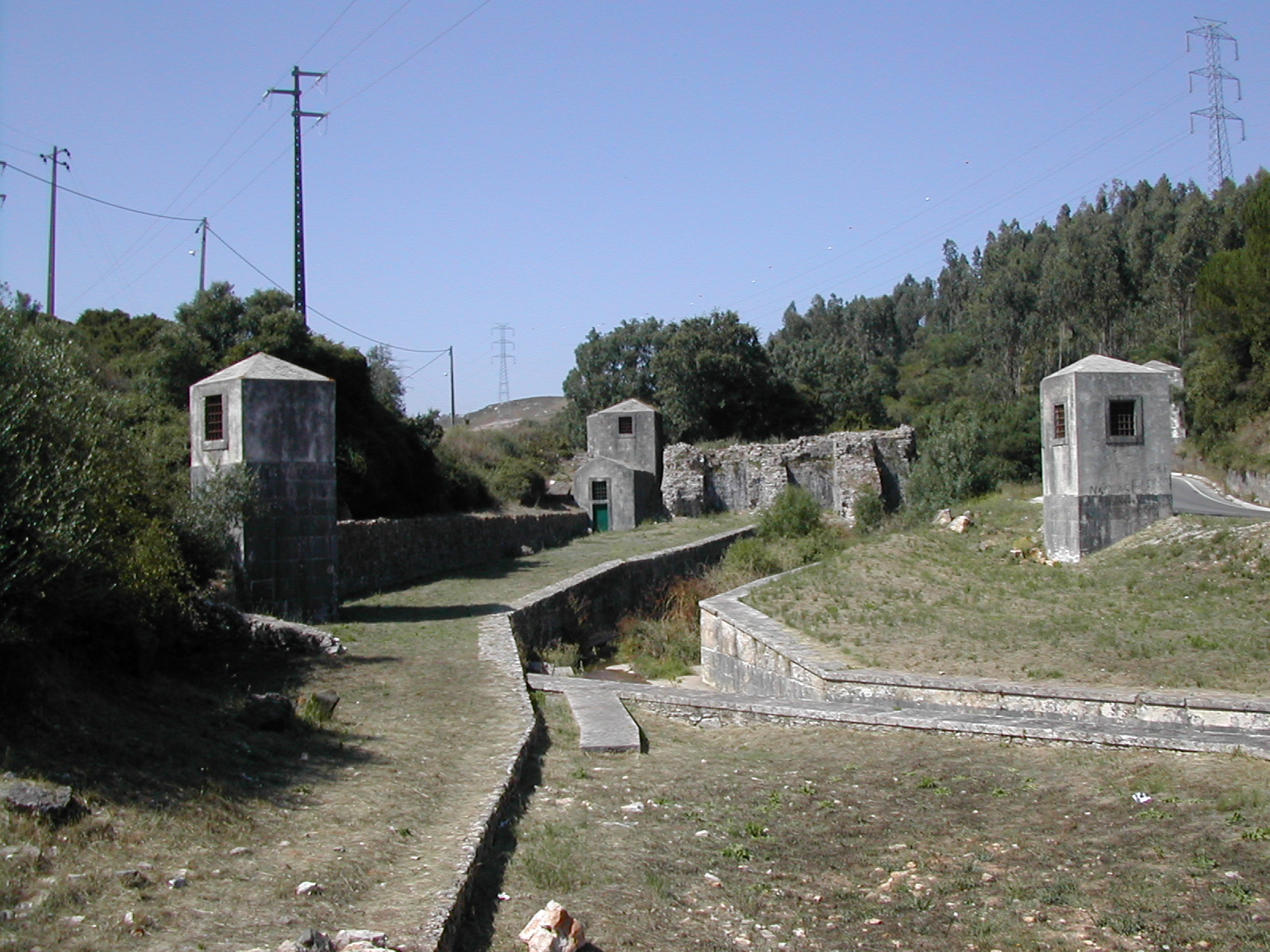
The Roman Dam of Belas (Portuguese: Barragem Romana de Belas) is a 3rd-century Roman barrier constructed to serve the city of Olisipo, located in civil parish of Queluz e Belas, municipality of Sintra (in the Portuguese district of Lisbon).
Book your tour near
Roman Dam of Belas
Book Now
4.4
in partnership with
GetYourGuide.com
Gallery

Sponsored
Location
1 explorer visited this place

2.2 km
The Monumento ao Bombeiro or Monument to the Firefighter is a monument/memorial located in the civil parish of Belas, in the municipality of Sintra, in the central region of Portugal.
The Monumento was designed to honour the service and sacrifice of several firemen, who lost their lives in 1967, during their efforts to rescue people during the torrential downpours that breached the banks of the Jamor River, causing heavy flooding. In addition to the firemen, many people lost their lives and extensive property damage.
Dedicated to Belas' Volunteer Firefighters, the monument was officially dedicated on 24 November 2002, with the presence of the Secretário de Estado adjunto do Ministério da Administração Interna, Luís Pais de Sousa and president of the municipality, Fernando Seara, along with other politicians, dignitaries and officials, marking the 35th anniversary of the tragedy. In a speech addressing the crowd, the president of the parish council, Guilherme Dias, reminded the crowd that the statute "served to demonstrate to the people, the respect [we] have for the firefighters. At the bottom we transform in bronze our collective sentiment". In addition to the inauguration, the event served to inaugurate the new vehicles and forest-fighting equipment, ambulances and generators that were acquired for the institution.
A medal was impressed officially to honour the firefighters and pay homage to the people who died in the tragedy.
The monument was designed and created by the artist Bottelho.

2.2 km
The Necropolis of Carenque is an archaeological site consisting of three well-preserved late Neolithic collective sepulchres or tombs, dating back to about 3000 BCE, which are dug into smooth limestone outcrops. It is situated in the municipality of Amadora in the Lisbon District of Portugal.

2.4 km
The Natural Monument of Carenque is a natural monument in Belas, Sintra, Portugal. It contains more than one hundred dinosaur footprints and has one of the longest dinosaur tracks in Europe. The original footprints have been covered with soil after being molded onto latex, so the Monument has no pedagogical or tourist use.
The Pego Longo dinosaur footprint deposit was discovered in 1986 by two Geology students from the Faculty of Sciences of the University of Lisbon, Carlos Coke and Paulo Branquinho, in a deactivated quarry located southwest of Belas. However, it was named after the neighboring town of Carenque. This monument consists of a set of subcircular and tridactyl footprints containing one of the largest tracks in Europe, with an extension of approximately 140 m. It is possible to observe a fossil record with hundreds of dinosaur footprints from the beginning of the Upper Cretaceous on a track over 120 m, of 2 herbivorous four-legged dinosaurs and tridactyl ichnites, possibly of bipedal carnivores.
In this protected area, there is also the existence of the Necropolis of Carenque, which dates back to the Paleolithic period and the beginning of the Neolithic period.
This monument, namely most of the main trail, was in danger of being destroyed by the Lisbon Regional Circular Road. The solution was to open tunnels so as not to destroy the track.

2.7 km
The Anta das Pedras Grandes is a Late Neolithic site located in Ramada e Canecas, in the Odivelas municipality, in the Lisbon District of Portugal. Anta is the Portuguese name for about 5,000 megaliths built during the Neolithic period in the area of Portugal. It was classified as a National Monument in 1944. Excavations in the early 21st century suggest that it was originally built as a dolmen or single chamber megalithic tomb, consisting of a polygonal long chamber with eight supporting stones about 3 metres tall, and a short access corridor. There are traces of a tumulus, and human bones have been discovered. Excavations in the surrounding area also identified many flint chippings, suggesting that the area was used for the production of flint items.
The site was first identified in 1880 by the Portuguese archaeologist Carlos Ribeiro. It is the only surviving dolmen in the immediate area although several were discovered in the late 19th and early 20th centuries. Nevertheless it has suffered considerably from the use of stones by farmers and for construction.
The Anta das Pedras Grandes now forms the centrepiece of a small urban park, which was officially opened in late 2018. The remaining stones, which had all fallen, were lifted, to provide a clearer impression of the original architecture of the megalith.

2.8 km
Caneças is a former civil parish in the municipality of Odivelas, Portugal. In 2013, the parish merged into the new parish Ramada e Caneças. It is a suburb of the Greater Lisbon region.