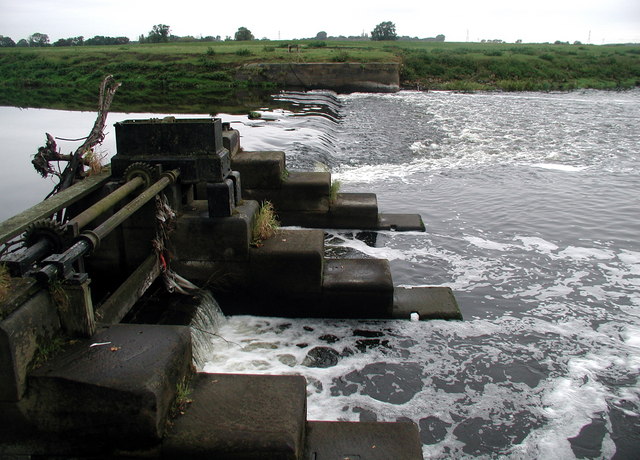
Beal is a village and civil parish in North Yorkshire, England. It is situated on the River Aire, 3.5 miles (6 km) north-east of Knottingley, 8 miles (13 km) south-west of Selby, and 21 miles (34 km) south of York. The parish includes the village of Kellingley, and borders the City of Wakefield in West Yorkshire. At the 2001 census it had a population of 720, increasing to 738 at the 2011 census.

Nearby Places View Menu
Location Image
1.1 km

St Mary's Church, Birkin

St Mary's Church is the parish church of Birkin, a village in North Yorkshire, in England. The church was built in the 12th century, and survives largely intact from the period. A south aisle was added in the 14th century, when the top stage of the tower was also added. The church was restored in 1882 by John Oldrid Scott. It was Grade I listed in 1967. The church is built of limestone with a stone slate roof, and has a wooden porch. It consists of a two-bay nave with a south aisle, a chancel and apse, and a west tower. The tower has two stages, slits in the lower stage, bands, the upper one with gargoyles, two-light bell openings, and an embattled parapet with pinnacles. On the south front is a later timber porch, and a Norman doorway of four orders with various carvings, and three colonnettes with capitals decorated with interlace and scallops. The nave has an embattled parapet, and around the body of the church is a corbel table with carvings including humans, masks, and animals. There are a variety of windows, some square headed, some round headed, and the east window has three lights and tracery. The east window of the south aisle has some 14th century stained glass. Inside the church is a 14th-century effigy of a man holding his heart in his hand. There is a 14th-century grave slab in the south aisle, and some 17th and 18th century monuments. There is a piscina in the south aisle with an ogee arch, and the font is dated 1663, but on an earlier base. In the churchyard is a Roman coffin, which is Grade II listed.
Location Image
1.4 km

Birkin, North Yorkshire

Birkin is a village and civil parish in the south-west of the county of North Yorkshire, England. It is north of the River Aire, near Beal, North Yorkshire. The closest town is Knottingley, in West Yorkshire, 4 miles (6 km) to the south-west. The parish had a population of 146 at the 2001 census, which fell to 141 at the 2011 census. Until 1974, it was part of the West Riding of Yorkshire. From 1974 to 2023 it was part of the district of Selby, it is now administered by the unitary North Yorkshire Council.
Location Image
1.8 km

Church of St Edmund King and Martyr, Kellington

The Church of St Edmund King and Martyr, Kellington, is a grade I listed 12th century church in the village of Kellington, North Yorkshire, England. Excavations at the site have revealed the 14th century tomb related to the Knights Templar, and in the 1990s, the foundations of the church were underpinned because of possible subsidence effects from the nearby Kellingley Colliery. Its separation from the village upon elevated land, makes it a local landmark and it has been commented upon throughout history. A stone with Medieval carvings upon it was found in the church and has given rise to a legend attached to it about a shepherd fighting a snake. The Kellington Serpent-Stone is one of the attractions of the church.
Location Image
1.8 km

Kellington Windmill

Kellington Windmill is a historic building in Kellington, a village in North Yorkshire, in England. The windmill was built in about 1800, to grind corn. It originally had four floors and was powered solely by wind, but a paraffin engine was added so it could be used during calm periods, and after the First World War the sails were no longer in use. Milling ended in 1927, and the building was disused until the Second World War, when it was used as a look out post by the Home Guard. It was converted into a house, but then became derelict. For a short time it was used to grow mushrooms, but was then reconverted into a house. The windmill was grade II listed in 1987. It is built of magnesian limestone with some rendering and brick infill. It contains doorways and casement windows, all under segmental arches. It originally had a cap, which is now missing.