


Le stade Pedro-Escartín (en espagnol : Estadio Pedro Escartín), également connu sous le nom de terrain de football Pedro-Escartín (en espagnol : Campo de fútbol Pedro Escartín) ou encore terrain de football municipal Pedro-Escartín (en espagnol : Campo de fútbol Municipal Pedro Escartín), est un stade de football espagnol situé à El Balconcillo, quartier de la ville de Guadalajara, en Castille-La Manche.
Location
1 explorer visited this place

1.3 km
The Academy of Military Engineering of Guadalajara was a military academy of the Spanish Army. It was located in Guadalajara, Spain and operated from 1833 to 1932.
The academy specialized in the training of military engineers and was recognized for its focus on technological and scientific education. In 1932, it was merged with the Artillery Academy, resulting in its relocation to Segovia.
This institution played a significant role in the professional development of military engineers within the Spanish Army during its operation.
The Academy was located in the Montesclaros Palace, in the west of the city, until a 1924 fire destroyed part of the premises and an important collection of models, documents, books, and artworks. Between 1924 and its final move, its activities were continued in the palace's annex buildings that today serve as the General Military Archive of Guadalajara and the Palace of Antonio de Mendoza.
A total of 115 graduating classes were trained at the academy, producing 2,213 engineering officers. Some of these officers contributed to the early development of Spanish military aeronautics. Notable individuals who served as instructors or studied at the institution include Mariano Barberán, Eduardo Barrón, Alejandro Goicoechea, Emilio Herrera Linares, Alfredo Kindelán, José Ortiz Echagüe, Carlos Faraudo and Pedro Vives Vich.
1.3 km
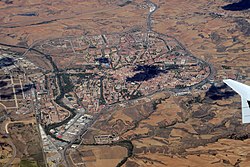
Guadalajara is a city and municipality in Spain, located in the autonomous community of Castilla–La Mancha. It is the capital of the Province of Guadalajara.
Guadalajara lies on the central part of the Iberian Peninsula at roughly 685 meters above sea level. Most of the city housing is located on the left bank of the Henares, in between the river and the moors of La Alcarria. In addition to the city, the municipality also includes the villages of Iriépal, Taracena, Usanos, and Valdenoches. As of 1 January 2025, Guadalajara has a registered population of 93,470, which makes it the region's second most populated municipality.
Founded in the 9th century as Madīnat al-Faraŷ under the Emirate of Córdoba, it became a stronghold of the Masmuda Berber clan of the Banū Sālim. After the Christian conquest of the Taifa of Toledo in 1085, it grew into a sizable town of the Crown of Castile under control of the Mendoza family. It was a hub for mystical iluminismo in the 16th century in the Kingdom of Toledo. Depopulation and decay of key economy parametres ensued in the 17th century. Growth in the 21st century was caused by its closeness to the functional urban area of Madrid.

1.3 km
The Church of los Remedios is an old church located in Guadalajara, Spain. It was declared Bien de Interés Cultural in 1924. Now, it's the auditorium of the University of Alcalá in Guadalajara.

1.4 km
The Tower of Álvar Fáñez is a tower located in Guadalajara, Spain, which served as part of the city's medieval defences.
It is a pentagonal ashlar stone structure that measures up to 14 meters high with two distinct levels. Access to each floor is through arched openings which are located on different sides of the building, adapted to the sloping terrain.
The rear facade was intentionally left open to prevent enemies from establishing positions if they managed to capture the fortification.
It is named after Álvar Fáñez, known as the 'Conqueror of Guadalajara for Christianity', a Leonese nobleman and military leader who played a significant role in the Christian reconquest of Spain during the 11th century. He was a lieutenant of El Cid.
It also served as a chapel dedicated to the Christ of the Mass, known as the Cristo de la Feria.
The tower was declared Bien de Interés Cultural in 1921. It went under restoration in 1986 and also a complete refurbishment in 2004. The building now holds an exhibition centre dedicated to the origins of the city's coat of arms and also tales about the legend of Álvar Fáñez.

1.4 km
Guadalajara railway station is a Spanish railway station owned by ADIF that serves the Spanish city of Guadalajara. There is another station outside the urban limits 5 km away from the city on the Madrid–Barcelona high-speed rail line called Guadalajara–Yebes railway station.
The Madrid–Guadalajara stretch was opened on 3 May 1859. Conversely, the Guadalajara–Jadraque stretch was opened on 5 October 1860.
Book your tour near
Stade Pedro-Escartín
Book Now
4.2
in partnership with
GetYourGuide.com
Le stade, doté de 8 000 places et inauguré en 1967, sert d'enceinte à domicile à l'équipe de football du Club Deportivo Guadalajara. Le stade porte le nom de Pedro Escartín, ancien footballeur.