

 English
 Français
ROF Leeds
Royal Ordnance Factory (ROF) Leeds, first opened as a munitions factory in December 1915 and opened as an ROF in January 1936, was one of a number of Royal Ordnance Factories created at the start of the Second World War.
Nearby Places View Menu

313 m
Charles H. Roe
Charles H Roe was a Yorkshire coachbuilding company. It was for most of its life based at Crossgates Carriage Works, in Leeds.
In 1947 it was taken over by Park Royal Vehicles. Two years later, along with its parent, it became part of Associated Commercial Vehicles (ACV) in 1949, which was merged with Leyland Motors in 1962. In 1965, 30% of Park Royal and Roe's shares were exchanged by Leyland Motor Corporation for shares in Bristol Commercial Vehicles and Eastern Coach Works held by the Transport Holding Company (THC). Later the THC was succeeded by the National Bus Company (NBC) and Park Royal Vehicles, Charles H Roe, Bristol Commercial Vehicles, Eastern Coach Works and Leyland National Limited became subsidiaries of a new company Bus Manufacturers Holdings, 50% owned by British Leyland and 50% by NBC. Leyland took complete control in 1982 and closed Charles H Roe in September 1984. In the following year, a group of employees from the former business, began the Optare coachbuilding business in the former Roe carriage works.
402 m
Manston railway station (Yorkshire)
Manston railway station served the suburb of Manston, West Yorkshire, England, from 1834 to 1869 on the Leeds and Selby Railway.
547 m
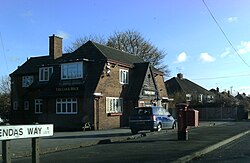
Pendas Fields
Pendas Fields, or Penda's Fields is a private, suburban housing estate in Leeds, West Yorkshire, England. It is considered part of Cross Gates, as is Manston. Swarcliffe is close, and Cock Beck runs nearby. The area falls within the Cross Gates and Whinmoor wards of the Leeds Metropolitan Council.
Pendas Fields and Barnbow Wood are associated with the Battle of the Winwaed in 655 AD (with "Pendas Fields" named for Penda of Mercia, the king who died at the battle).
It has its own sports centre and secondary school – John Smeaton Academy, named after 18th-century civil engineer John Smeaton.
Penda's Way railway station (opened in 1939) on the Cross Gates to Wetherby Line was in the area but closed in 1964 before the Pendas Fields estate was built in the 1980s.

614 m
Penda's Way railway station
Penda's Way railway station was a railway station on the Cross Gates–Wetherby line at the eastern edge of Cross Gates in West Yorkshire. The station opened on 5 June 1939 to serve a new housing estate and was named after a nearby battle where King Penda was killed. The station was named by Gertrude Bray, a local builder and politician who was responsible for developing the housing estate it served. It closed on 6 January 1964 together with the line and has been demolished entirely.
The station was intended to serve the increasing commuter traffic in the area. Its platforms, which were both 120 yards (110 m) long, and the waiting rooms, had been constructed of wood. A lattice footbridge connected the northern ends of the platforms. The station was staffed and handled parcels as well as baskets of homing pigeons, but it had no freight facilities.