

 English
 Français
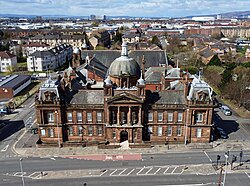
New Govan Parish Church
New Govan Parish Church, currently named Govan & Linthouse Parish Church, is a 19th-century church building located in the Govan area of Glasgow, Scotland. It is one of three church buildings of the Parish of Govan & Linthouse, however, it is considered as the main Parish church.
Nearby Places View Menu

87 m
Govan subway station
Govan subway station is a station that serves the area of Govan in Glasgow, Scotland. It is located on the south side of the River Clyde. Just south of the station is the main depot and test track for the Glasgow Subway. The station is located near the historic Govan Old Parish Church.
This station forms an interchange with Govan bus station, being adjacent to it. This, combined with the fact that the subway to Partick forms the only rail link across the Clyde west of the city centre, means that it is one of the busier stations. Annual passenger boardings have fallen below one million in recent years and with 990,000 recorded in 2004/05.
The station has two platforms. Prior to its closure for modernisation in 1977, the station was called Govan Cross. The appearance of cracks in the roof of the old station led to its premature closure in 1977, before the modernisation programme could take place. As part of this programme, the station's surface buildings were replaced, and its single island platform was changed to a dual side platform arrangement.
Govan (under its former name of Govan Cross) is one of the stations mentioned in Cliff Hanley's song The Glasgow Underground.
Govan includes a lift and escalator. Along with St Enoch subway station, it is one of two Glasgow Subway stations that is wheelchair accessible.
On 29 June 2011, a man died after being hit by one of the service's rolling stock at 09:12.
156 m
Govan railway station
Govan railway station was a railway station in Govan, a district of Glasgow, Scotland. The station was originally part of an extension to the Glasgow and Paisley Joint Railway.

208 m
Govan–Partick Bridge
The Govan-Partick Bridge is a footbridge in Glasgow, Scotland, designed to carry pedestrians and bicycles across the River Clyde, connecting Water Row in Govan to Pointhouse Quay in Partick, adjacent to the Riverside Museum. To allow ships including PS Waverley to pass by, its swing bridge main span can rotate to align with the south shore. The official opening ceremony on 6 September 2024 was followed by public access from the next day, when crowds celebrated with community events on both sides of the river.
The 110-metre-long (360-foot) bridge with its 8 m (26 ft) wide deck has step-free access, to carry bicycles, pedestrians, wheelchairs and buggies between Govan south of the river and Partick to the north. The V-shaped pylon design is inspired by the historic cranes at the riverside. It is one of the largest opening footbridges in Europe.
The work is intended to improve the economic conditions in Govan (which is a deprived area of the city) and is linked to the University of Glasgow and Glasgow City Council-led "West End Innovation Quarter" as part of the ongoing Clyde Waterfront Regeneration. The bridge lands at Water Row in Govan where a mixed use development of housing and commercial space is planned.
220 m
Govan
Govan ( GUV-ən; Cumbric: Gwovan; Scots: Gouan; Scottish Gaelic: Baile a' Ghobhainn) is a district, parish, and former burgh now part of southwest Glasgow, Scotland. It is situated 2+1⁄2 miles (4 kilometres) west of Glasgow city centre, on the south bank of the River Clyde, opposite the mouth of the River Kelvin and the district of Partick. Historically it was part of the County of Lanark.
In the early medieval period, the site of the present Govan Old churchyard was established as a Christian centre for the Brittonic Kingdom of Alt Clut (Dumbarton Rock) and its successor realm, the Kingdom of Strathclyde. This latter kingdom, established in the aftermath of the Viking siege and capture of Alt Clut by Vikings from Dublin in 870, created the stone sculptures known today as the Govan Stones.
Govan was the site of a ford and later a ferry which linked the area with Partick for seasonal cattle drovers. In the eighteenth and nineteenth centuries, textile mills and coal mining were important; in the early-nineteenth century, shipbuilding emerged as Govan's principal industry. In 1864, Govan gained burgh status, and was the fifth-largest burgh in Scotland. It was incorporated into the City of Glasgow in 1912.