

 English
 Français

Monton
Monton is a village in the City of Salford, Greater Manchester, England. It is contiguous with nearby Eccles, Salford and Swinton.
Lieux à Proximité Voir Menu

441 m
Monton Green railway station
Monton Green railway station is a closed station in Eccles.
Opened on 1 November 1887, Monton Green was the first station on the London and North Western Railway's Manchester and Wigan Railway, which connected Eccles with Wigan and the Tyldesley Loopline which connected Tyldesley, Leigh and Kenyon Junction. Other stations on the line were located at Worsley and Ellenbrook. The station was built on an embankment at the road junctions of Canal Bank and Parrin Lane in Monton.
The Tyldesley Loopline was earmarked for closure in the Beeching Report, and Monton Green closed on 5 May 1969, along with the rest of the line.
Since closure, the embankment spanning Monton Green has been demolished. However, the embankment running parallel to the Bridgewater Canal has been preserved as part of Salford City Council's Recreation Pathways scheme. The route is popular with walkers & cyclists, as the path gives excellent views over the local area.
476 m
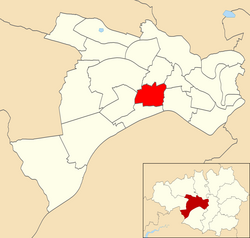
Eccles (ward)
Eccles (ward) is an electoral ward of Salford, England. It is represented in Westminster by Rebecca Long-Bailey MP for Salford and Eccles. A profile of the ward conducted by Salford City Council in 2014 recorded a population of 11,499.

491 m
Monton Unitarian Church
Monton Unitarian Church is a Unitarian church on Monton Green in Monton, a village in the City of Salford, Greater Manchester, England. Built between 1873 and 1875 to the designs of Thomas Worthington, it is an example of Gothic Revival architecture and is regarded as one of the architect's most accomplished Nonconformist churches. It is recorded in the National Heritage List for England as a Grade II* listed building.

581 m
Monton Mill, Eccles
Monton Mill was a cotton spinning mill in Eccles, Greater Manchester, England, built in 1906. It was taken over by the Lancashire Cotton Corporation in the 1930s and passed to Courtaulds in 1964. After production ended, it was demolished and replaced with housing; its name is preserved in the street name.