
Location Image

Queen's Hall, Dunoon

Queen's Hall is a building in Dunoon, Argyll and Bute, Scotland. Standing at 9 Argyll Street, adjacent to Castle Hill, it has been the town's multi-function building since 1958. It was formerly known as the New Pavilion, having replaced the 1905 Dunoon Public Pavilion. The building was officially opened by Queen Elizabeth II on 11 August 1958. It contains three meeting rooms, an activity room and the Olympian Suite, in addition to its large main hall. The main hall has a stage with professional sound and lighting equipment, and has attracted popular acts such as Pink Floyd, Blur, the Saw Doctors, David Gray, Morrissey, the Red Hot Chilli Pipers, Primal Scream and comedians Kevin Bridges, Bill Bailey and Roy Chubby Brown. In late 2015, the building was closed to enable a major refurbishment, to a design by Malcolm Fraser Architects, but this did not begin until January 2017. Queen's Hall reopened in August 2018. Dunoon Library has shared part of the building's first floor since being moved from Castle House Museum in 2018. In 2025, the collection was downsized and moved to another part of the building.

Nearby Places View Menu
Location Image
101 m

High Kirk, Dunoon

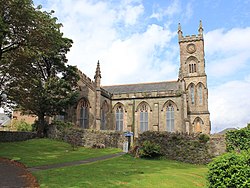
High Kirk, also known as the Old Parish Church, is a Church of Scotland church building in Dunoon, Cowal, Argyll and Bute, Scotland. It is located on Kirk Street, just south of the town centre. Constructed in the Gothic Revival style, it is a Category B listed building. After being scheduled for closure, the final service was held at the church on 1 October 2023.
Location Image
173 m

Dunoon Pier

Dunoon Pier is a Victorian pier in Dunoon, Argyll and Bute, Scotland. It is owned by Argyll and Bute Council, and was completed in its current form in 1898. Reaching out into the Firth of Clyde, the earliest parts of the pier date to 1835. It is now a Category A listed structure (upgraded from Category B in 2011) and, according to Historic Environment Scotland, the best surviving example of a timber ferry pier in Scotland. The pier is constructed of Greenheart timber piles, first built in 1835. A more substantial structure followed in 1841 after tourism to the town had increased. This second incarnation was destroyed in a storm three years later. It was rebuilt the following year and extended in 1867 by Campbell Douglas. The pier was purchased in 1868 by James Hunter, of Hafton House, and was "considerably enlarged, with every convenience for passenger and goods traffic". A ferry also ran from the pier to Cloch lighthouse at one stage. The pier was extended to the current structure between 1896 and 1898. It was shortened to allow the building of a breakwater in 2005, just to the south of the pier. As well as protecting the pier and its architecture from storm surges, a new link span was installed alongside the breakwater. This was to allow the berthing and loading of roll-on/roll-off ferries instead of the side-loading ferries that used to serve the pier. A tender to serve the new link-span between two interested parties, Caledonian MacBrayne and Western Ferries, came to nothing. Prior to June 2011, the pier was in daily use by Caledonian MacBrayne, who ran a regular foot passenger and car-ferry service to Gourock. However, after June 2011, a renewed tendering process produced a passenger-only ferry service (Argyll Ferries, owned by Caledonian MacBrayne) using the breakwater for berthing. On 1 September 2004, during the construction of the breakwater, the cargo vessel Jackie Moon (82 metres in length) ran aground on the breakwater, with six people on board. Since the breakwater became operational in June 2011, Argyll Ferries operate from this docking facility. The Waverley struck the breakwater on 26 June 2009, with some 700 people on board. The pier was partially refurbished by Argyll and Bute Council during 2015. Now containing meeting rooms, it is purely a tourist attraction.
Location Image
187 m

Dunoon Primary School

Dunoon Primary School is a school in Dunoon, Argyll and Bute, Scotland. It is located in a Category B listed building dating from 1901. The school accommodates 300 pupils.
Location Image
202 m

Dunoon massacre

The Dunoon massacre was a massacre that took place around Dunoon, Scotland, on 3 June 1646. Men of Clan Campbell massacred men, women and children of the Clan Lamont. By 1646, the Clan Campbell, neighbours of the Clan Lamont, had steadily encroached the Lamont's lands. After the 1645 Battle of Inverlochy near Fort William, the Clan Lamont took the opportunity to lay waste to the Campbell's territory. The following year, the powerful Clan Campbell army invaded the Clan Lamont lands, taking their castles of Toward on Cowal and Asgog on the banks of Loch Asgog on South West Cowal. At Castle Toward the Campbells asked for hospitality, which was given, according to custom, and then slaughtered the Lamonts in their beds, before throwing bodies down the well to poison the water. James Lamont surrendered after accepting fair terms for his people, but the Campbells reneged on the terms and took the Lamonts captive. The two castles were set alight and razed, and the prisoners were transported by boat to Dunoon, where the Campbells slaughtered over two hundred of Lamont's men, women and children. Thirty-six men were killed by hanging, while the rest were stabbed to death or buried alive. James Lamont was thrown into a dungeon for five years. This event became known as the Dunoon massacre. The massacre is commemorated by a memorial in Dunoon, dedicated in 1906 and known as the Clan Lamont Memorial or the Dunoon Massacre Memorial.