


La cathédrale de Magliano Sabina ou église Saint-Libérateur (en italien : cattedrale di San Liberatore Vescovo e Martire, chiesa di San Liberatore), est une église catholique romaine de Magliano Sabina, en Italie. Il s'agit de la cocathédrale du diocèse suburbicaire de Sabina-Poggio Mirteto.
Gallery


Sponsored
Location
1 explorer visited this place

156 m
The Archaeological Museum of Magliano Sabina is housed in Palazzo Gori. It is distributed over three floors, two of which can be visited by users, and one is reserved for the warehouse and restoration laboratory. The artifacts are displayed according to provenance and presented in chronological succession, which makes it possible to trace the fundamental lines of civilization in the Tiber Valley.
764 m
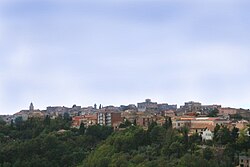
Magliano Sabina is a comune in the Province of Rieti in the Italian region of Latium, at Tiber Valley, located about 50 kilometres north of Rome and about 30 kilometres west of Rieti. As of 31 December 2004, it had a population of 3,829 and an area of 43.7 square kilometres.
Magliano Sabina borders the following municipalities: Calvi dell'Umbria, Civita Castellana, Collevecchio, Gallese, Montebuono, Orte, Otricoli. Its frazione of Foglia is one of I Borghi più belli d'Italia.
The Cathedral is also known as the Concattedrale di San Liberatore Vescovo e Martire.
3.2 km
Foglia is a frazione of the Italian comune of Magliano Sabina, in the province of Rieti, Lazio.

6.8 km
Poggio Sommavilla or Poggetto is a frazione of Collevecchio, Lazio region at Tiber Valley in Italy. It is known for the discovery of archaeological finds from prehistory.
7.2 km
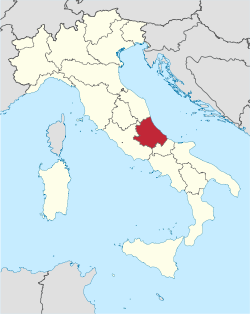
Abruzzo, historically also known as Abruzzi, is a region of Southern Italy. It has an area of 10,831.84 square kilometres and a population of nearly 1.3 million. It is divided into four provinces: L'Aquila, Teramo, Pescara, and Chieti. Its western border, shared with Lazio, lies 80 km east of Rome. L'Aquila is both the capital city of the Abruzzo region and of the Province of L'Aquila, and is the second largest city. The other provincial capitals are Pescara, which is Abruzzo's largest city and major port, Teramo, and Chieti. Other large cities and towns in Abruzzo include the industrial and high tech center Avezzano, as well as three important industrial and touristic centers, Vasto, Lanciano, and Sulmona.
Abruzzo borders the region of Marche to the north, Lazio to the west and northwest, Molise to the south, and the Adriatic Sea to the east. Geographically, Abruzzo is divided into a mountainous area in the west, which includes the highest massifs of the Apennines, such as the Gran Sasso d'Italia and the Maiella, and a coastal area in the east, with beaches on the Adriatic Sea.
Culturally, Abruzzo is considered a region of Southern Italy; however, geographically it is often considered part of Central Italy. Because of its historic association with the Kingdom of the Two Sicilies, the Italian statistical authority ISTAT deems it to be part of Southern Italy.
Abruzzo is known as "the greenest region in Europe" as half of the region's territory is protected through national parks and nature reserves, more than any other region in Italy. There are three national parks, one regional park, and 38 protected nature reserves. These ensure the survival of rare species, such as the golden eagle, the Abruzzo chamois, the Apennine wolf, and the Marsican brown bear. Abruzzo's parks and reserves host 75% of Europe's animal species. The region is also home to Calderone, one of Europe's southernmost glaciers.
Nineteenth-century Italian diplomat and journalist Primo Levi chose the adjectives forte e gentile to capture what he saw as the character of the region and its people. Forte e gentile has since become the motto of the region.