


L'ancien hôtel de ville de Weimar est un bâtiment Renaissance vert et blanc du XVe siècle situé sur le côté est de la place du marché (Markplatz) de Weimar, dans le Land allemand de Thuringe.
Gallery


Sponsored
Location
1 explorer visited this place
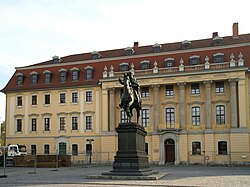
140 m
The University of Music Franz Liszt Weimar is an institution of music in Weimar, Germany.
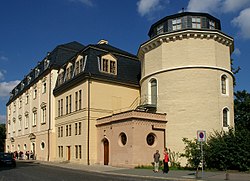
143 m
The Duchess Anna Amalia Library in Weimar, Germany, houses a major collection of German literature and historical documents. In 1991, the tricentennial of its opening to the public, the Ducal Library was renamed for Duchess Anna Amalia. Today, the library is a public research library for literature and art history. The main focus is German literature from the Classical and the late Romantic eras. The ducal library was supplied, among others, by the bookseller Hoffmann from Weimar as well as with publications from France and Europe by the Strasbourg publishing house Bauer, Treuttel and Würtz. The library was inscribed on the UNESCO World Heritage List as part of the Classical Weimar site because of its testimony to the global cultural importance of Weimar during the late 18th and early 19th centuries during the Weimar Classicism movement.
In 2004 a fire destroyed the main wing and a substantial part of the collection; restoration of salvaged volumes lasted until 2015.

150 m
Schloss Weimar is a Schloss in Weimar, Thuringia, Germany. It is now called Stadtschloss to distinguish it from other palaces in and around Weimar. The building is located at the north end of the town's park along the Ilm river, Park an der Ilm. It forms part of the World Heritage Site "Classical Weimar", along with other sites associated with Weimar's importance as a cultural hub during the late 18th and 19th centuries.
From the middle of the 16th century it was the residence of the Dukes of Saxe-Weimar and, after they inherited the Duchy of Saxe-Eisenach in 1741, of Saxe-Weimar and Eisenach, which became the Grand Duchy of Saxe-Weimar-Eisenach from 1809 until the German revolution of 1918–1919. Names in English include Palace at Weimar, Grand Ducal Palace, City Palace and City Castle.
In history, it was often destroyed by fire. The Baroque palace from the 17th century, with the church Schlosskirche where a number of works by Johann Sebastian Bach were premiered, was replaced by a Neoclassical structure after a fire in 1774. Four rooms were dedicated to the memory of poets who worked in Weimar, Johann Wolfgang von Goethe, Johann Gottfried Herder, Friedrich Schiller and Christoph Martin Wieland. From 1923, the building has housed the Schlossmuseum, a museum with a focus on paintings of the 15th and 16th centuries and works of art related to Weimar, a cultural centre.
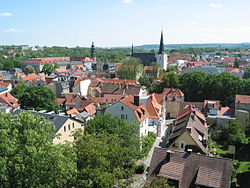
207 m
Weimar is a city in the German state of Thuringia, in Central Germany between Erfurt to the west and Jena to the east, 80 km southwest of Leipzig, 170 km north of Nuremberg and 170 km west of Dresden. Together with the neighbouring cities of Erfurt and Jena, it forms the central metropolitan area of Thuringia, with approximately 500,000 inhabitants. The city itself has a population of 65,000. Weimar is well known because of its cultural heritage and importance in German history.
The city was a focal point of the German Enlightenment and home of the leading literary figures of Weimar Classicism, Johann Wolfgang von Goethe and Friedrich Schiller. In the 19th century, composers such as Franz Liszt made Weimar a music centre. Later, artists and architects including Henry van de Velde, Wassily Kandinsky, Paul Klee, Lyonel Feininger, and Walter Gropius came to the city and founded the Bauhaus movement, the most important German design school of the interwar period.
The political history of 20th-century Weimar was volatile: it was the place where Germany's first democratic constitution was signed after the First World War, giving its name to the Weimar Republic, which existed between the end of World War I and the rise of the Nazis. It was also one of the cities mythologized by Nazi propaganda.
Until 1948, Weimar was the capital of Thuringia. Many places in the city centre have been designated as UNESCO World Heritage Sites, either as part of the Classical Weimar complex or the Bauhaus complex. Heritage tourism is one of the leading economic sectors of Weimar.
Noted institutions in Weimar are the Bauhaus University, the Liszt School of Music, the Duchess Anna Amalia Library, and two leading courts of Thuringia. In 1999, Weimar was the European Capital of Culture.
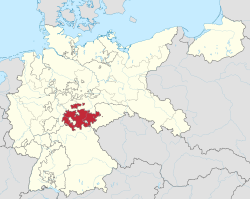
207 m
The State of Thuringia was a state of the Weimar Republic from 1920 to 1933, of Nazi Germany from 1933 to 1945 and of East Germany from 1949 to 1952. Following German reunification, the renamed Free State of Thuringia became a member state of the Federal Republic of Germany in 1990.
The State of Thuringia formed in the aftermath of World War I and the German revolution of 1918–1919. The eight small Thuringian states that had been part of the German Empire drove out their ruling royal houses and adopted republican constitutions in 1918–1919. On 1 May 1920, all except Coburg, which chose to become part of Bavaria, combined to create the State of Thuringia within the Weimar Republic.
From the beginning, Thuringia's Landtag was politically fractured, leading to a series of short-lived, unstable governments. When the Communist Party was brought into a coalition in 1923, the German government sent troops into Thuringia's major cities to force the communist ministers to withdraw. In 1929 Thuringia became the first German state to have members of the Nazi Party in its government. The year they were in office is seen as Adolf Hitler's trial run for his rise to power. The Nazis gained full control of the Thuringian government in August 1932, five months before Hitler became chancellor of Germany.
After World War II, Thuringia became part of the Soviet Occupation Zone and then of East Germany. It was enlarged by the addition of the Erfurt district, which had been part of Prussia, and in 1948 Erfurt replaced Weimar as the state's capital. In 1952, Thuringia was split into three regional districts and formally dissolved by the East German government in 1958.