


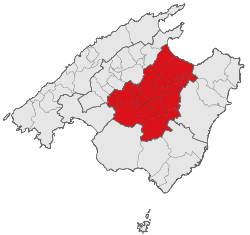
La Pla de Mallorca (officiellement en catalan ; anciennement Llanura de Mallorca) est une comarque de l'île de Majorque de la communauté autonome des Îles Baléares en Espagne. Son nom signifie la « plaine de Majorque » en raison de la nature de ses terrains et de leur utilisation pour les cultures agricoles irriguées (légumes, blé et même riz) qui s'opposent aux régions plus montagneuses ou vallonnées de l’île, la plaine étant alimentée en eau via le système orofluvial venant essentiellement des montagnes ou collines qui l'encadre sur 3 côté jusqu'à côte au nord-est de l'île.
Location
1 explorer visited this place
0 m
Pla de Mallorca is a comarca in the middle of the Mallorca island, Balearic Islands, Spain.
It includes the following municipalities:
Algaida
Ariany
Costitx
Lloret de Vistalegre
Llubí
Maria de la Salut
Montuïri
Muro
Petra
Porreres
Sant Joan
Santa Eugènia
Sencelles
Sineu
Vilafranca de Bonany

5.7 km
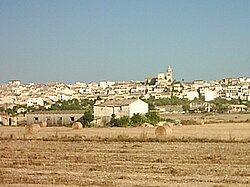
Mallorca, also spelled Majorca in English, is the largest of Spain's Balearic Islands, and the seventh largest island in the Mediterranean Sea.
Its capital, Palma, is also the capital of the autonomous community of the Balearic Islands. The Balearic Islands have been an autonomous region of Spain since 1983. Two smaller islands lie just off the coast of Mallorca: Cabrera and Dragonera. The island's anthem is "La Balanguera".
Along with other Balearic Islands, Menorca, Ibiza, and Formentera, Mallorca is a highly popular holiday destination, particularly for tourists from the Netherlands, Ireland, Germany, and the United Kingdom. The international airport, Palma de Mallorca Airport, is one of the busiest in Spain; it was used by 28 million passengers in 2017, with use increasing every year between 2012 and 2017.


9.4 km
The Astronomical Observatory of Mallorca is an observatory just south of Costitx, Mallorca, Spain.
The observatory was inaugurated in May 1991 and was the first astronomical center in the Balearic Islands autonomous community and province of Spain.
The observatory is a pioneer among Spanish observatories and uses robotic telescopes to discover and track asteroids.
Researchers at the OAM have found asteroids that are potential threats to Earth, such as the 2006 WH1.
Salvador Sánchez is director of the OAM.
In 2008, asteroid number 128036, discovered at the OAM in 2003, was named after Spanish tennis player Rafael Nadal.
As of 2008, the OAM tracks more than 2,000 asteroids.
There is a large planetarium attached to the observatory, which often runs performances open to the public. The Open University is one of a number of academic institutions which runs summer schools at the observatory.
In March 2017, the observatory has closed and gone into liquidation. The land will be up for auction at €1.7 million.